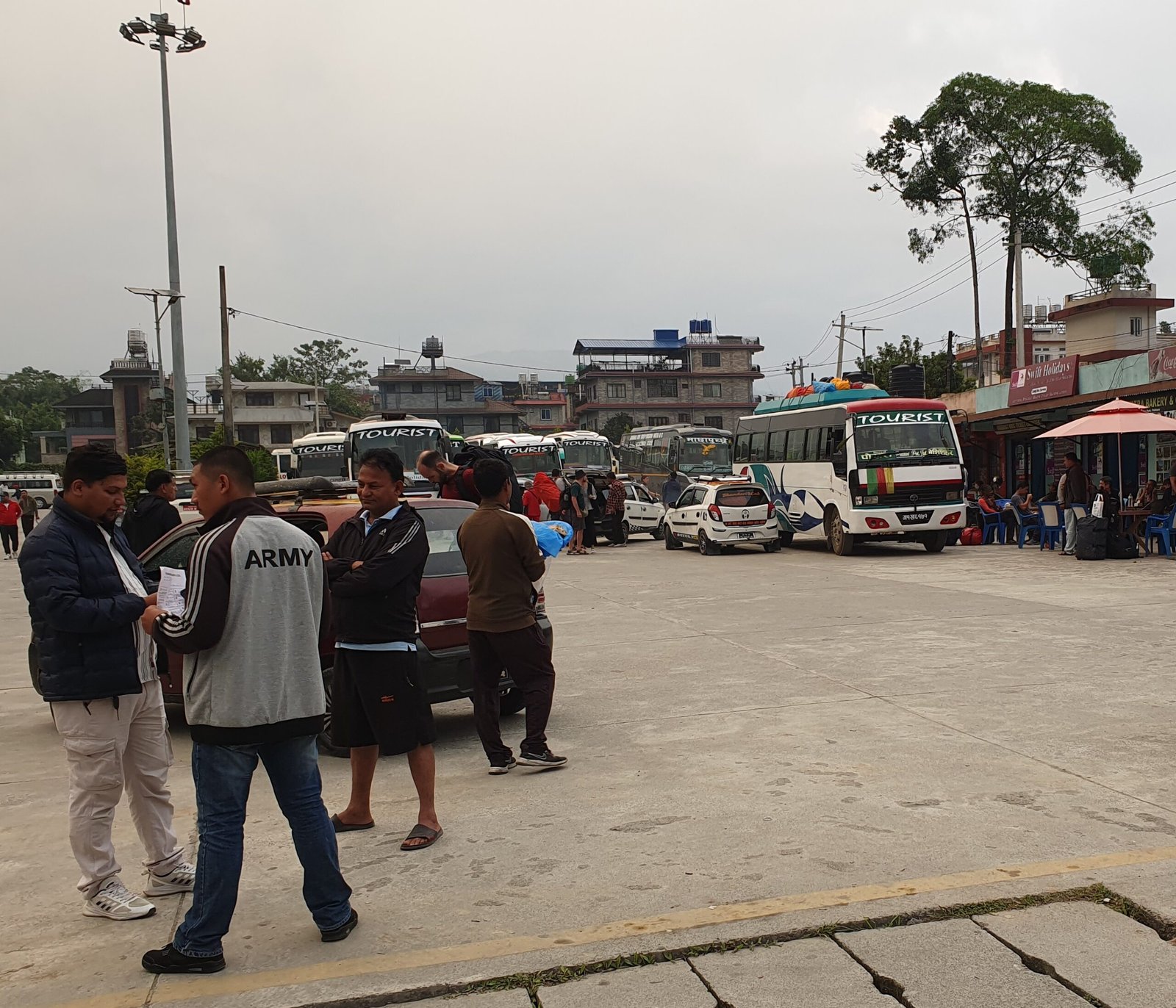
In the morning we had an early wake-up call, as a taxi would pick us up at 6:30am to take us to the bus station. As we left before the breakfast time, we were given a foil-wrapped picnic breakfast consisting of a sandwich, boiled egg, apple and a small juice carton to take with us. The bus station was located surprisingly far from the city center, but there was hardly any traffic in the morning and the journey didn’t take very long. Pokhara in general isn’t nearly as crowded as Kathmandu.
Pokhara bus station
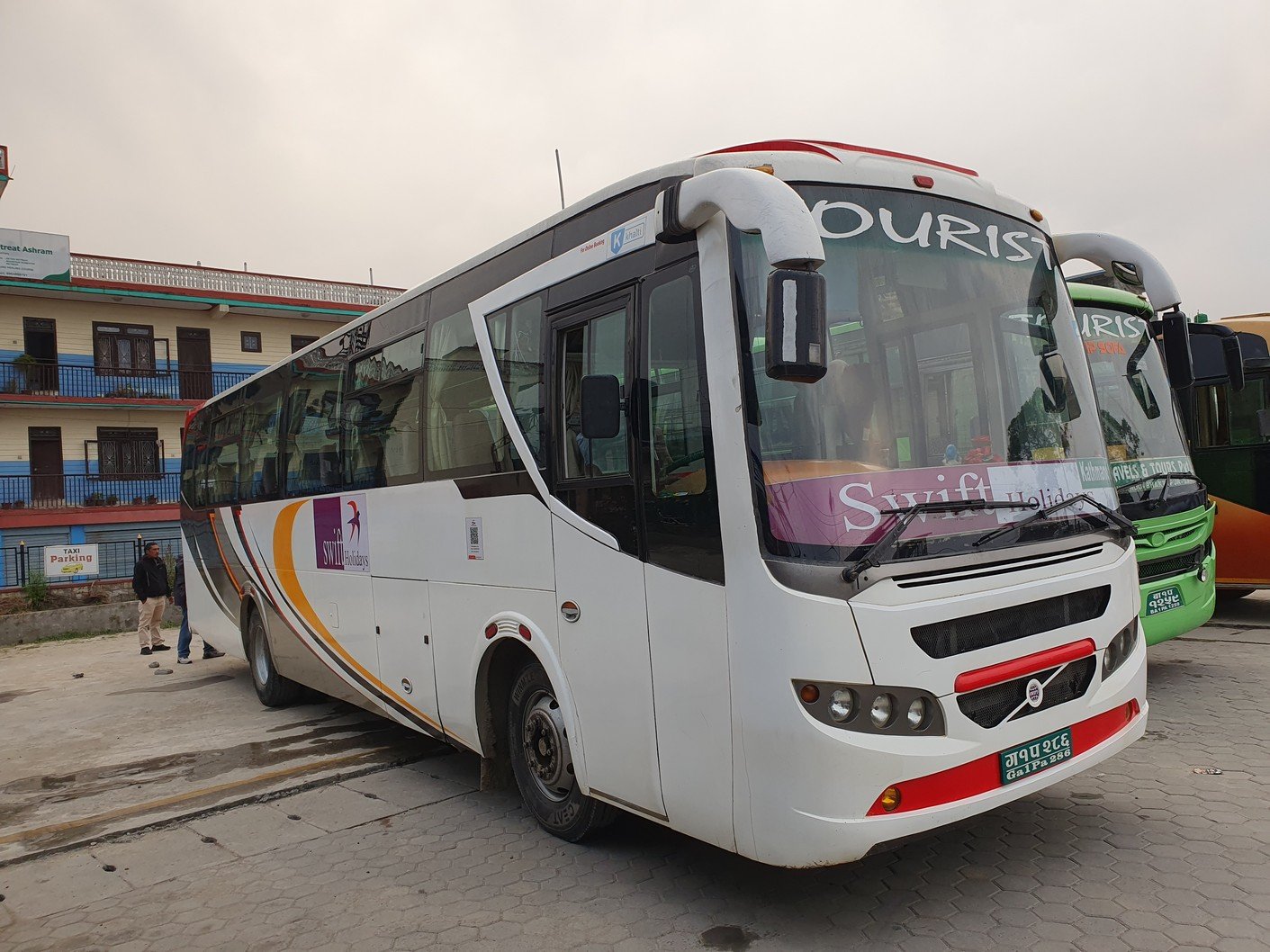
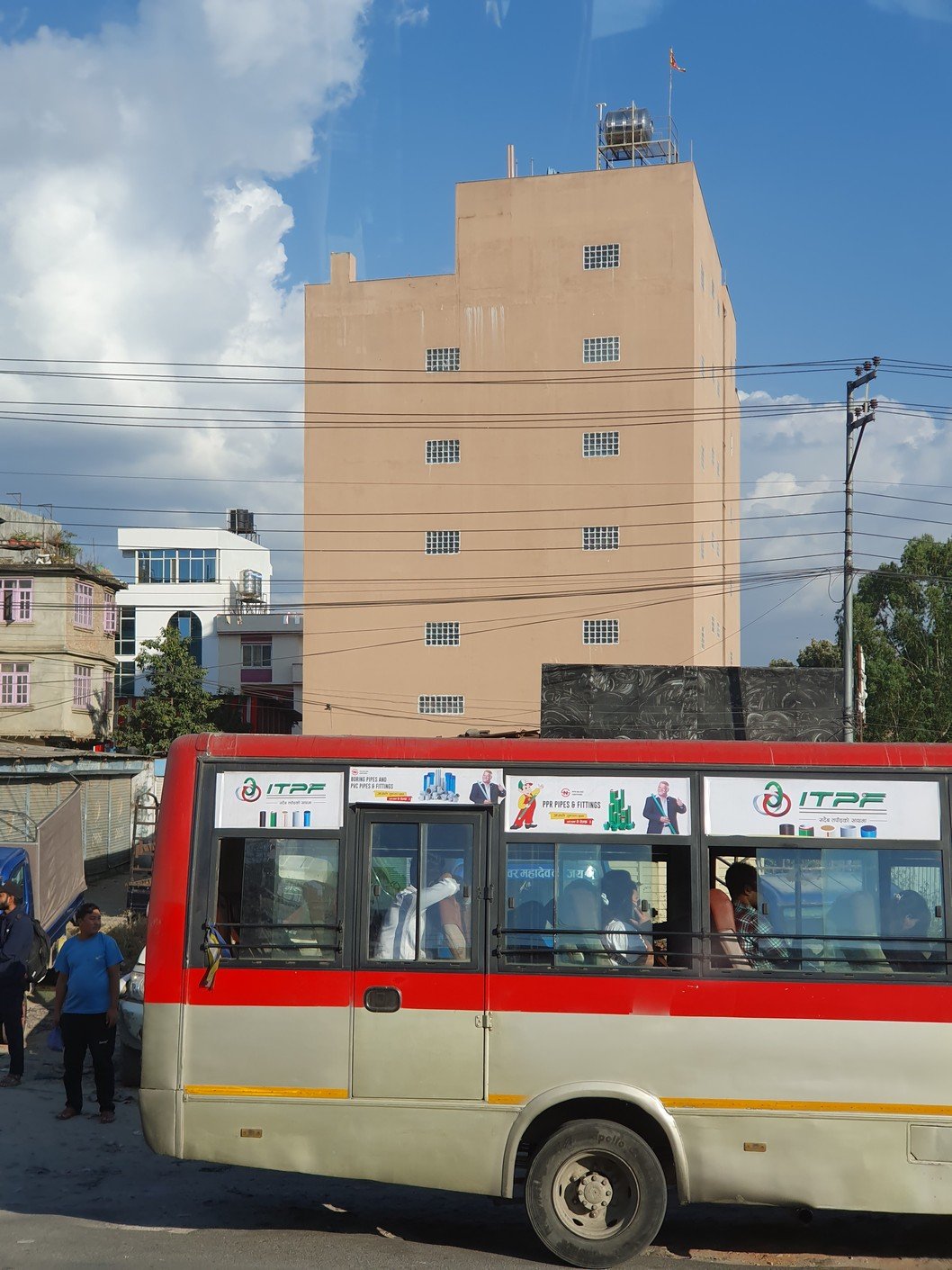
This time the bus was what we would call a bus even back home. No luggage on the roof or all over the middle aisle, and no one was taken on board who waved their hand at the side of the road. We were traveling between the capital and the second largest city in Nepal. The road is supposed to be the country’s primary highway, but it doesn’t exactly resemble for example the Helsinki – Tampere highway. The distance between Pokhara and Kathmandu is just over two hundred kilometres, so you might think that the journey would take four hours. But it doesn’t. The bus left a bit before seven in the morning and there was a 15 minute toilet break and a half hour lunch break along the way. It had already taken several hours to get to the lunch spot and after lunch Amrit estimated that we could be in Kathmandu by four o’clock. WTF?!?. But Amrit must have done this trip quite a few times and knew what he was talking about. We arrived at four o’clock, after eight hours of driving, excluding breaks. The mathematically inclined can calculate the average speed from that.
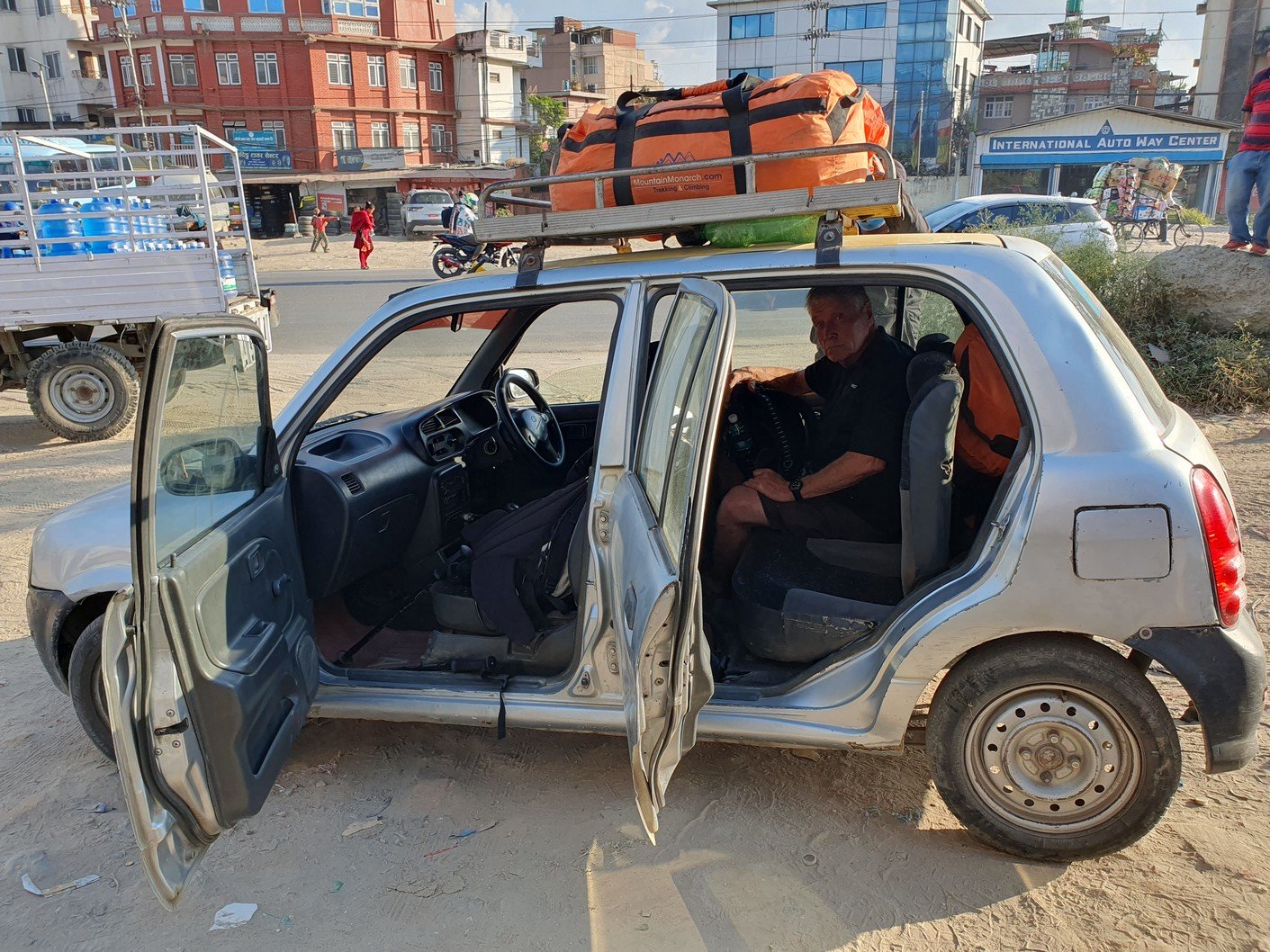
In Kathmandu we jumped off at the local ring road near the Thamel area. We were immediately attacked by a horde of taxi drivers, but luckily we didn’t have to start haggling with them. Amrit negotiated a local fare with a driver, who left to pick up his tiny car parked nearby. There was a strong correlation between the price and the car.
A real bus. Figuratively and literally.
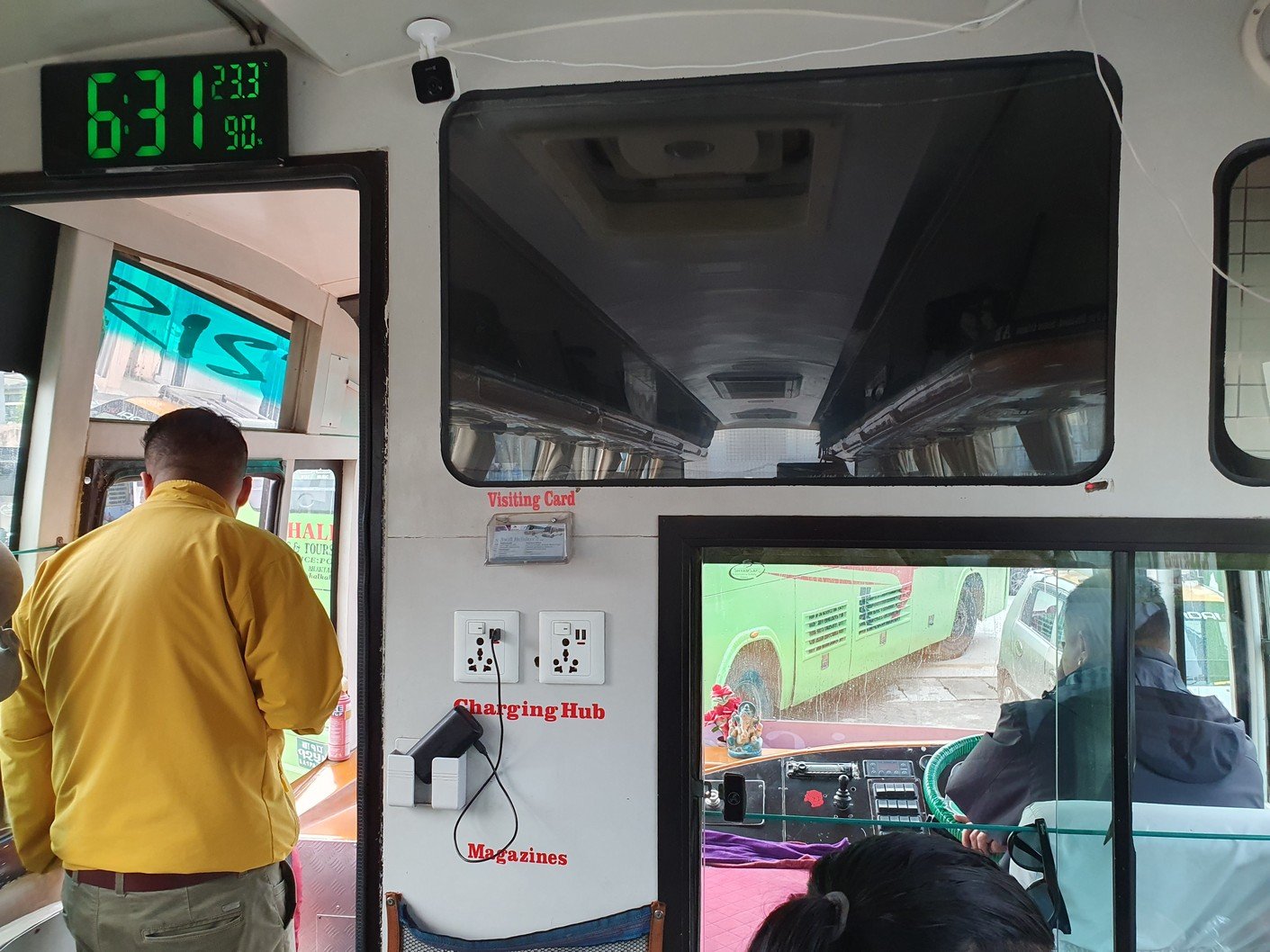
The clock showed what it wanted, but apparently the charging plugs worked
Picnic lunch from the hotel
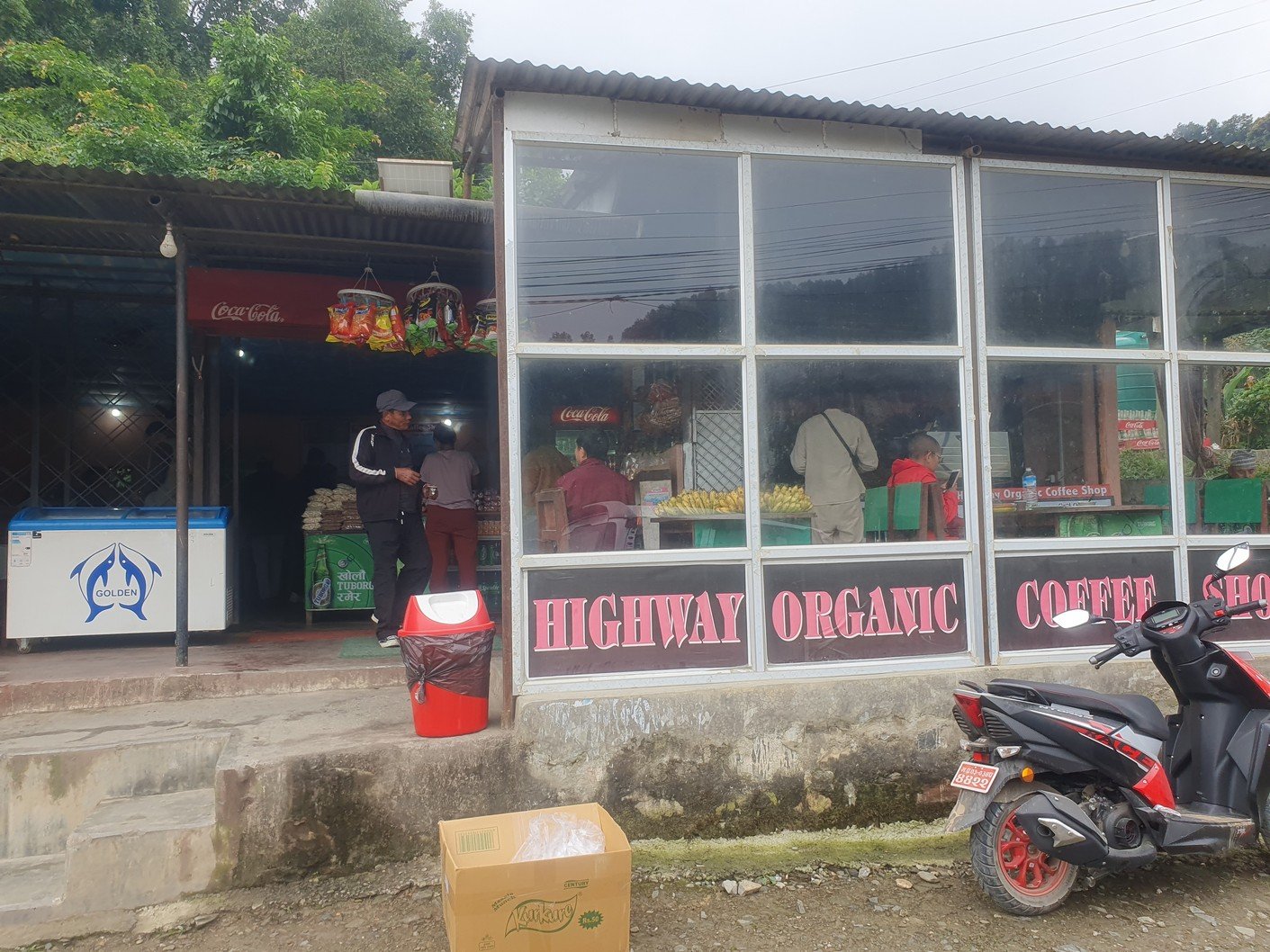
Toilet and coffee break
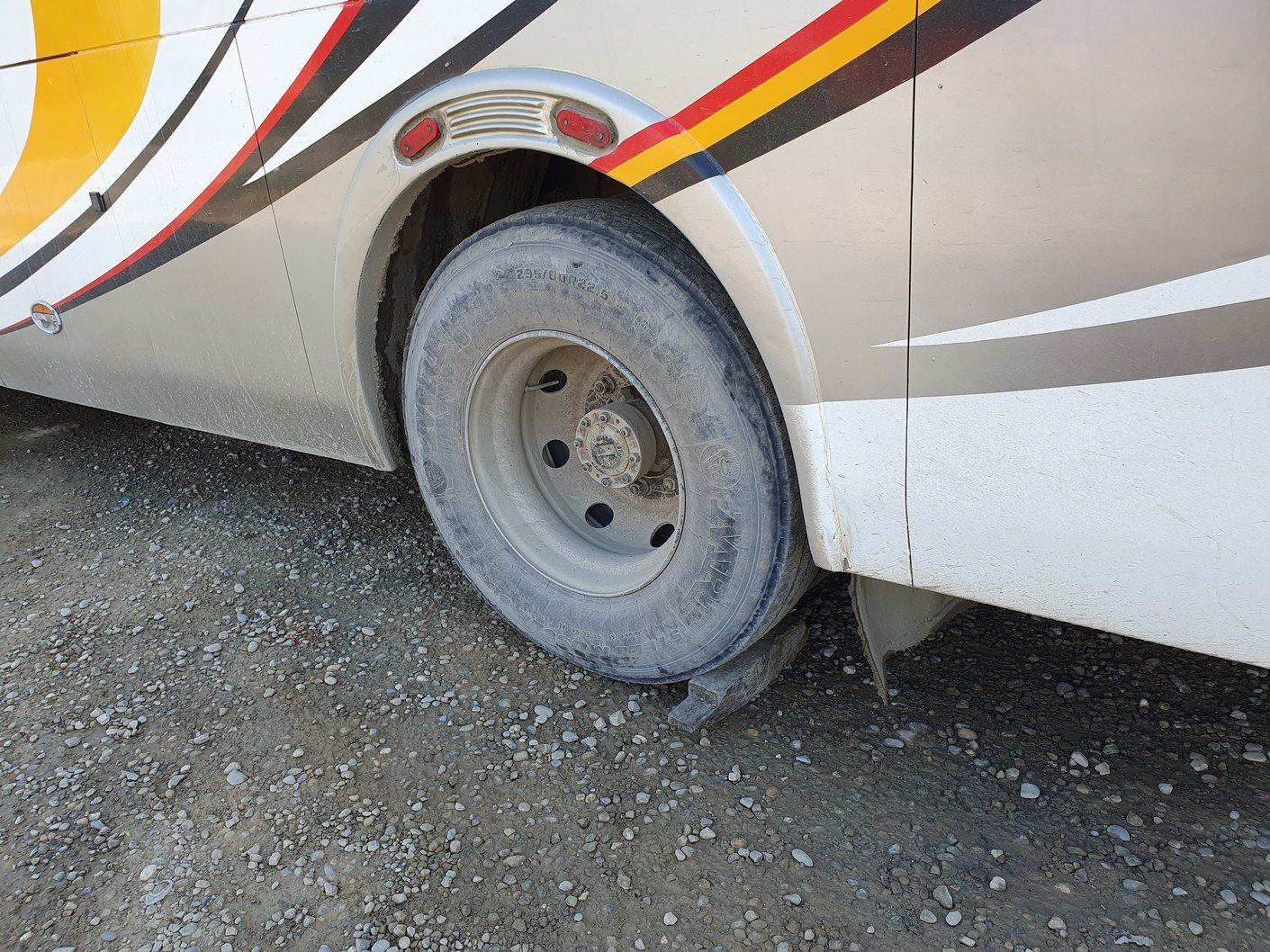
Ensuring the bus won't run away during the break
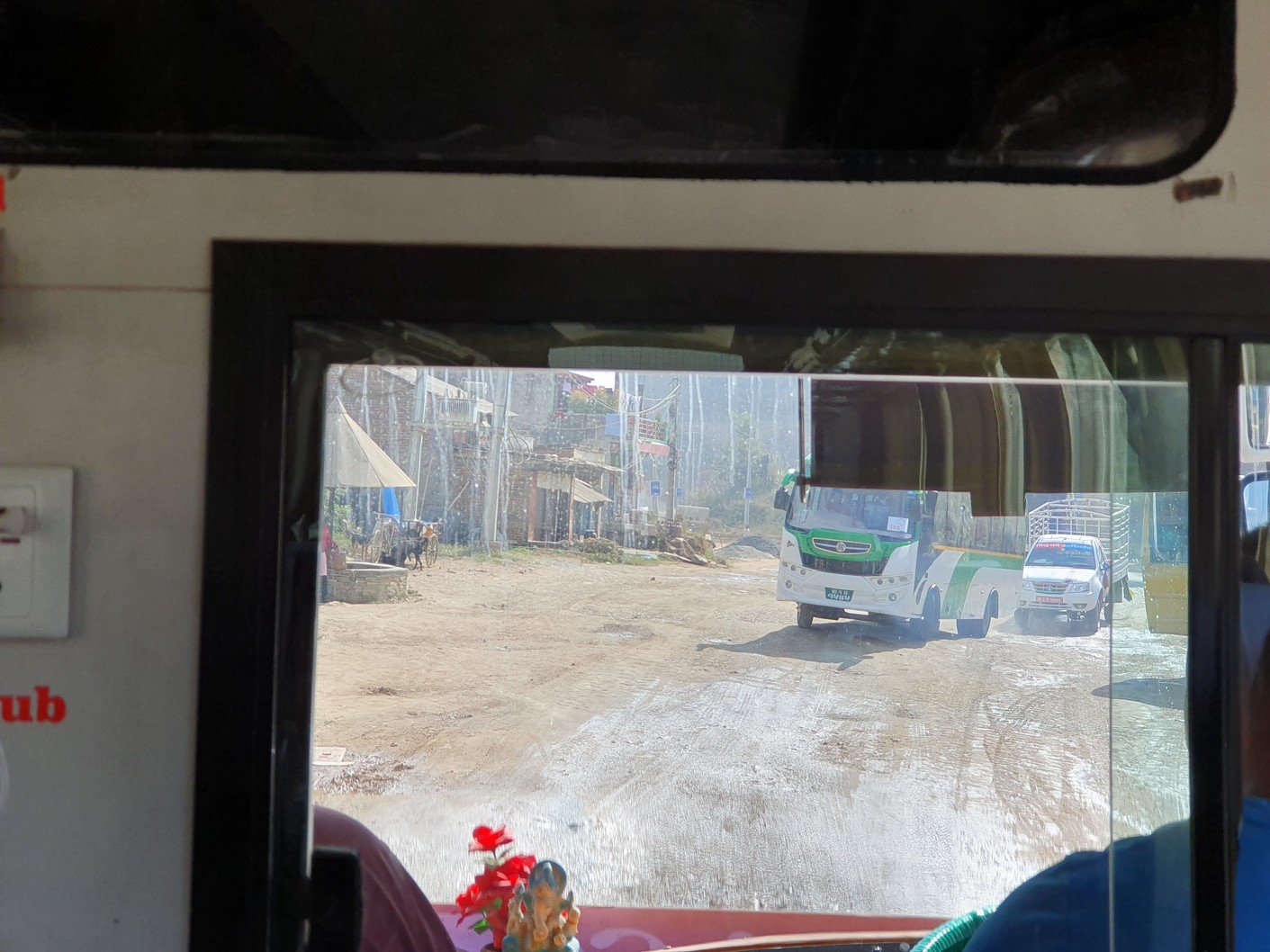
The highway between the capital and the second largest city. A rather distant cousin of the Tampere highway back home.
Playing chicken...
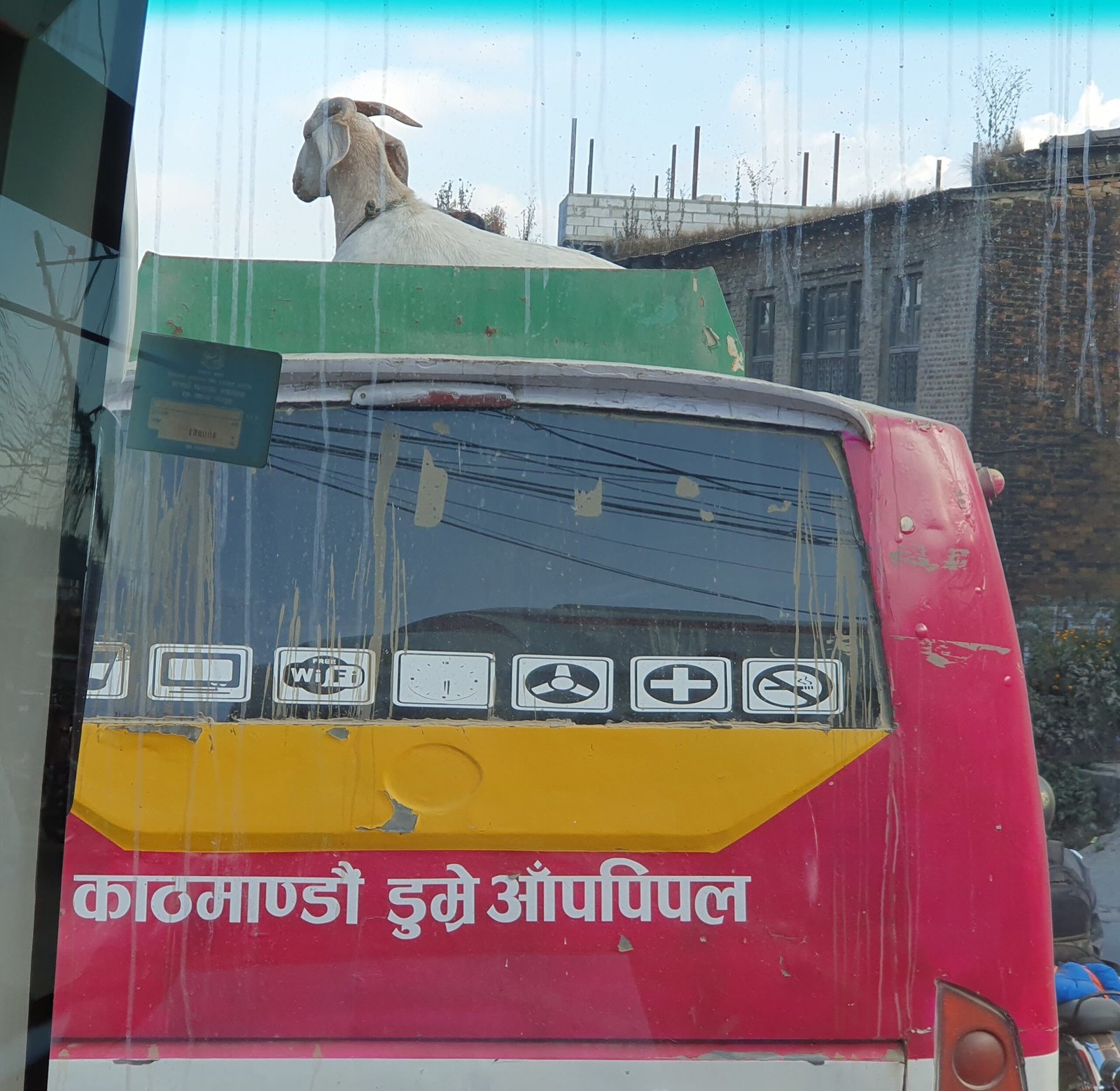
In Finland, secret passengers are called rabbits. The truth is stranger than fiction.
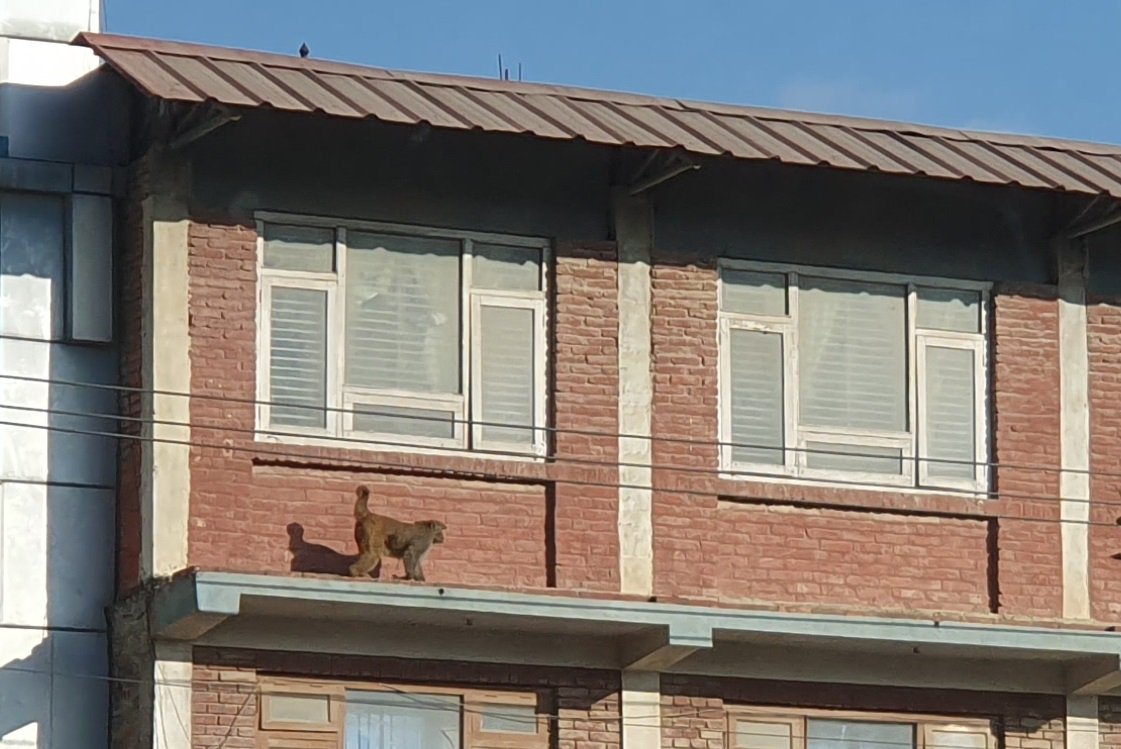
A little surprise may await you on the balcony.
European concrete brutalism pales in comparison to Nepal.
Four dudes, a driver and gear bags. A rather tight fit!
After arriving in Kathmandu, we said goodbye to Amrit. He left to run his own errands in the evening and would set off on his motorbike towards his home village early the next morning. Although we had had a full day off in Pokhara, we were in Kathmandu for a full day before the official 27-day duration of the trip. This meant that instead of one night, we were entitled to two more nights at the Harati Inn hotel in the heart of Thamel, used by the tour operator. However, our flights were not until Saturday, so we had all booked our own rooms for two more days at the Divine Hotel, where we had already spent the day of our arrival and we had been very happy with the hotel.
Back in Kathmandu
The Harati Inn seemed to be a hotel used by many tour operators, as the entire clientele seemed to consist of trekkers and there were constant gatherings in the lobby for groups going on or coming from different treks. Suddenly we spotted a familiar looking guy. It was Dan Mazur, the leader of SummitClimb and the Cho Oyu expedition where Heikki and I had participated in in 2008. Heikki had later also been on an expedition to Lhotse organised by Dan.
Dan Mazur, a man of eight 8000m summits, and a couple of clients from previous years
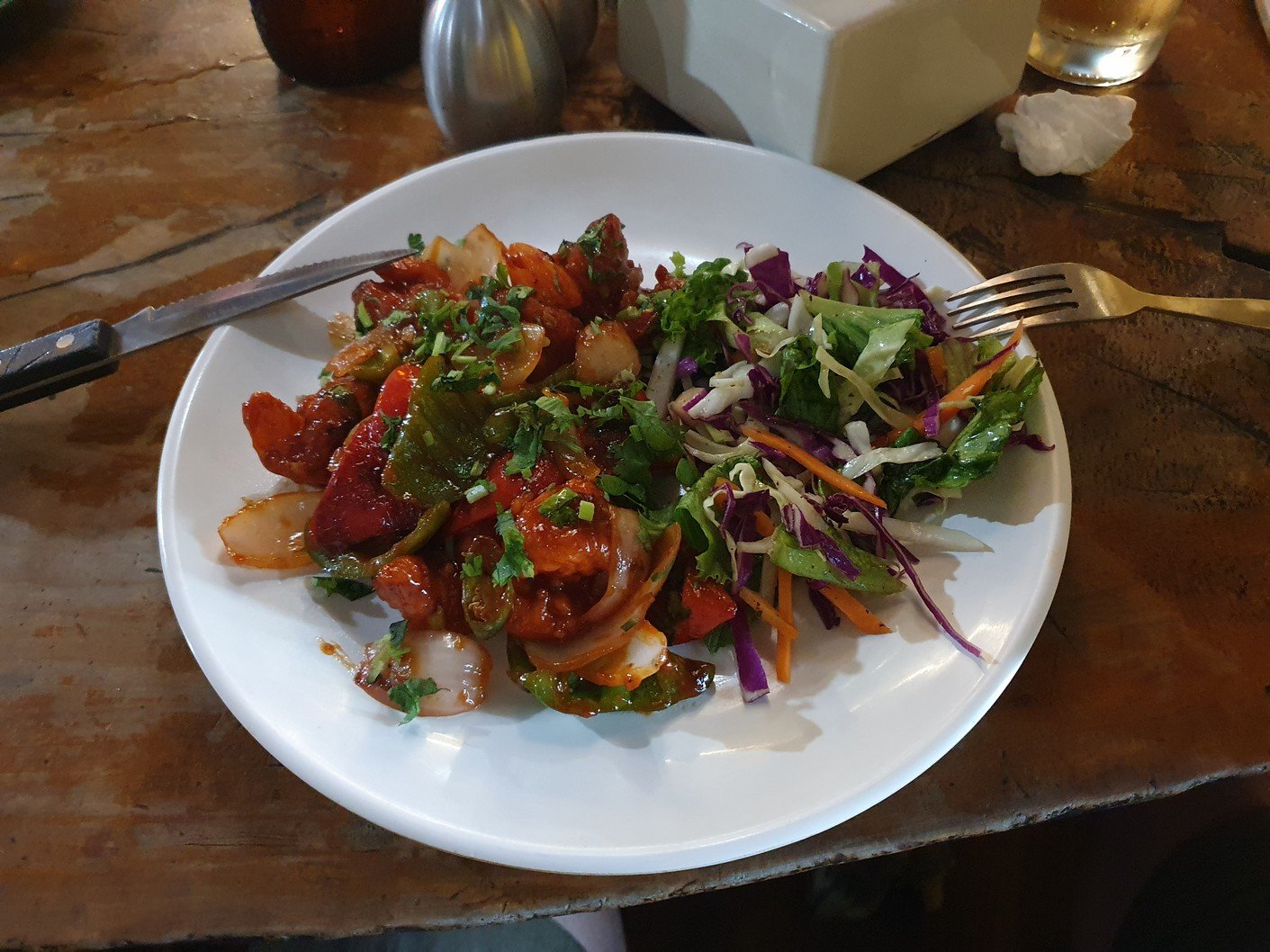
After a long day of travelling, we started to be really hungry. Pude had found online a restaurant called K-Too in Thamel, where we headed. The menu was so full of all kinds of delicacies that we had to order both starters and main courses. The chili prawns for six euros for starters were absolutely fantastic. Probably ten king prawns with onions, peppers and a strong chili sauce. The chicken pieces with similar garnishings were also perfect for building fajitas. The menu also included a few Nepali wines. When I was about to order a glass of local red wine, the waiter told me point blank that it might not be worth it. He said it wouldn’t be what we were used to and the restaurant had a wide selection of international wines as well. I didn’t give in and got a glass of local red liquid. The bland and sweet taste reminded me of communion wine, but I bravely finished it. It might have been a little disrespectful to leave the glass almost full.
Chili prawns
Fajitas and a local red wine-like product
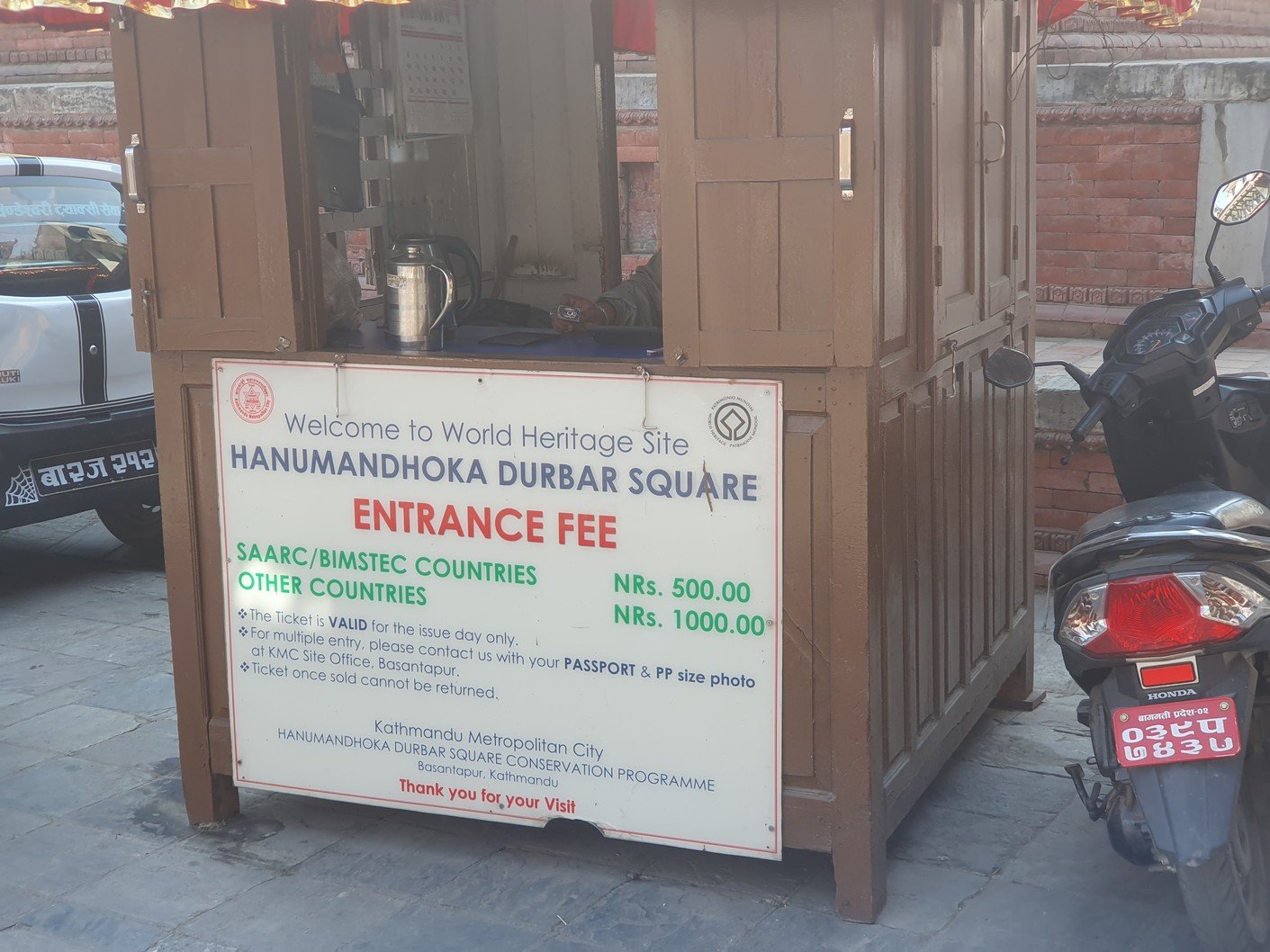
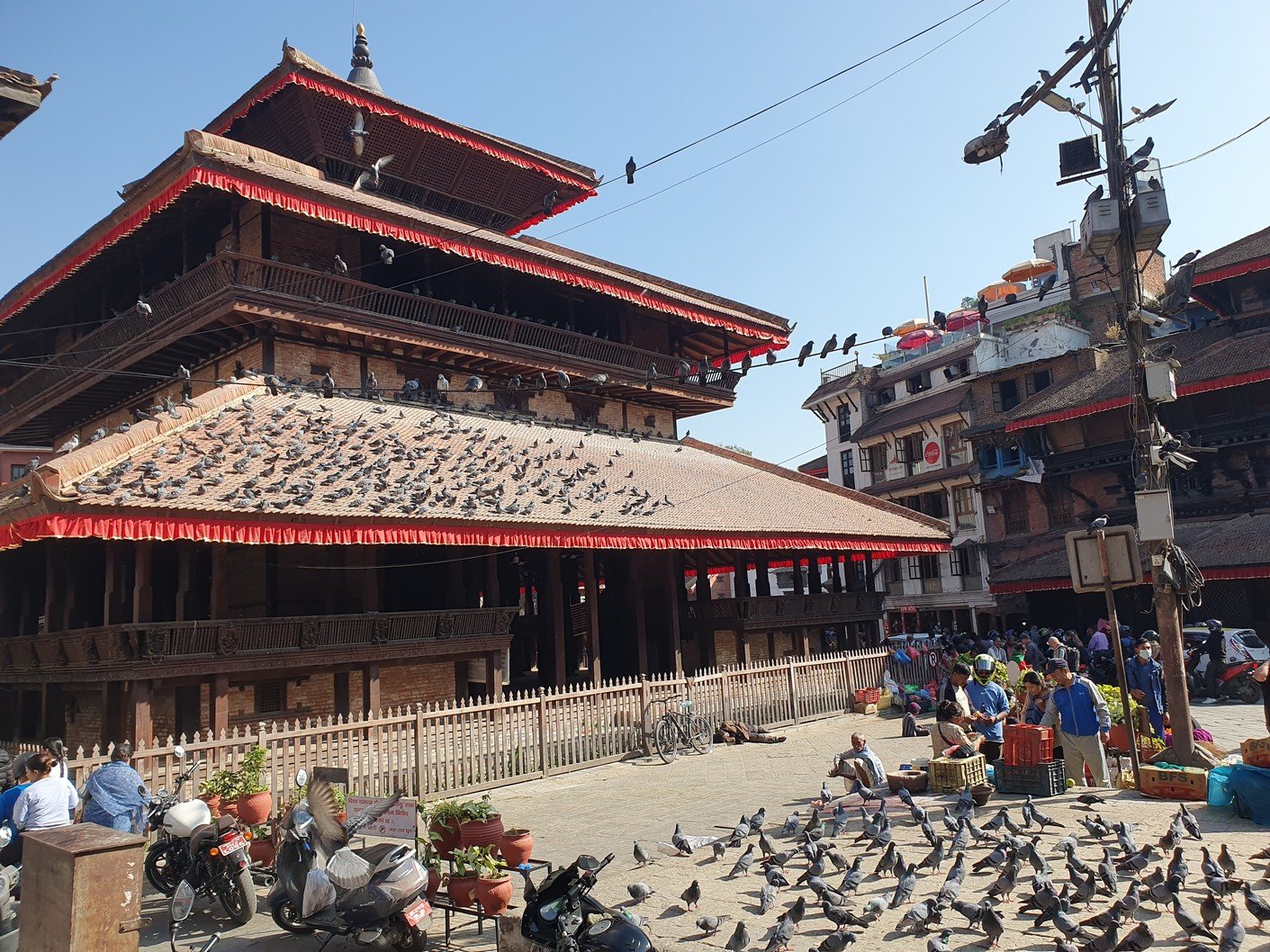
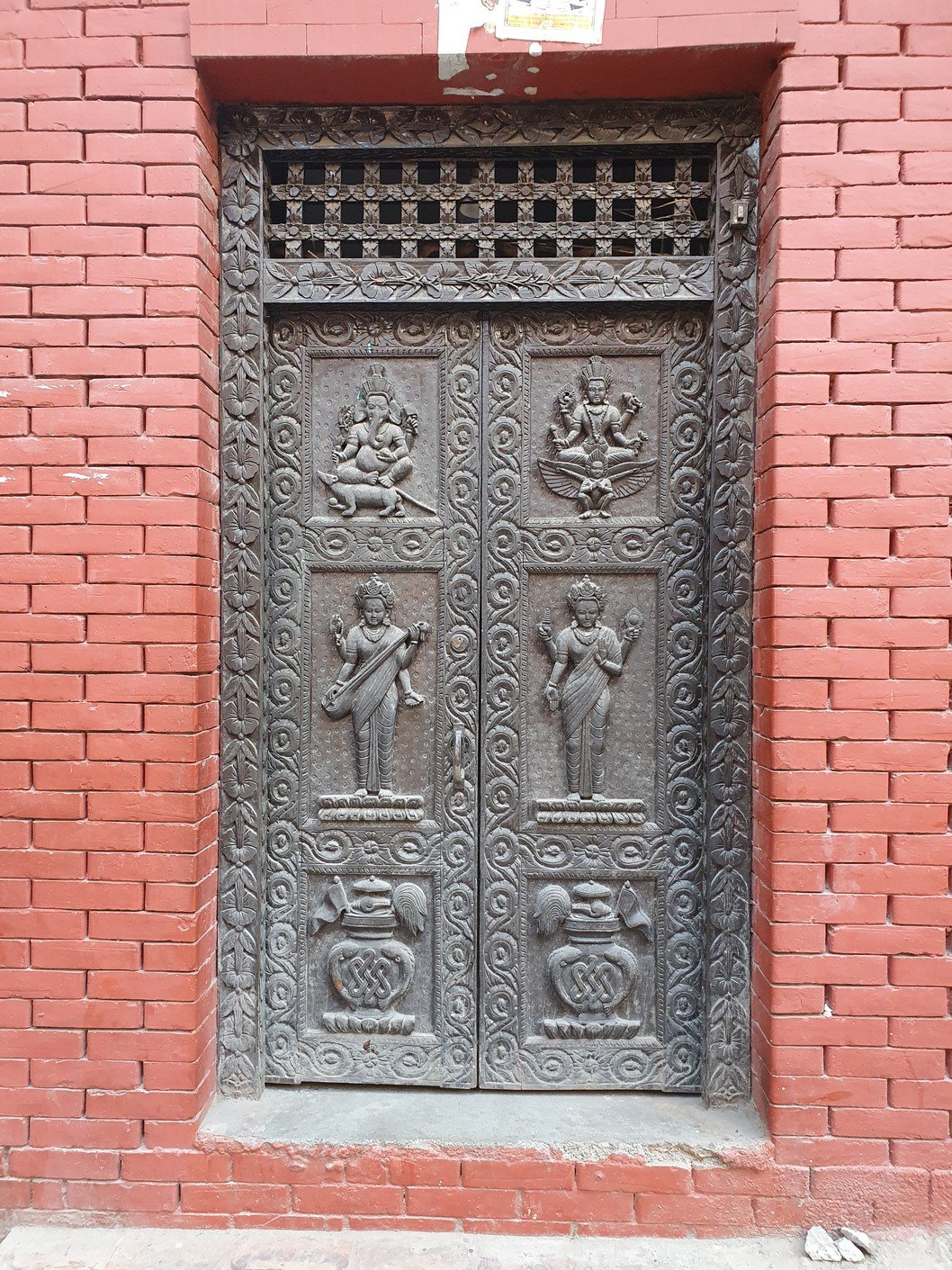
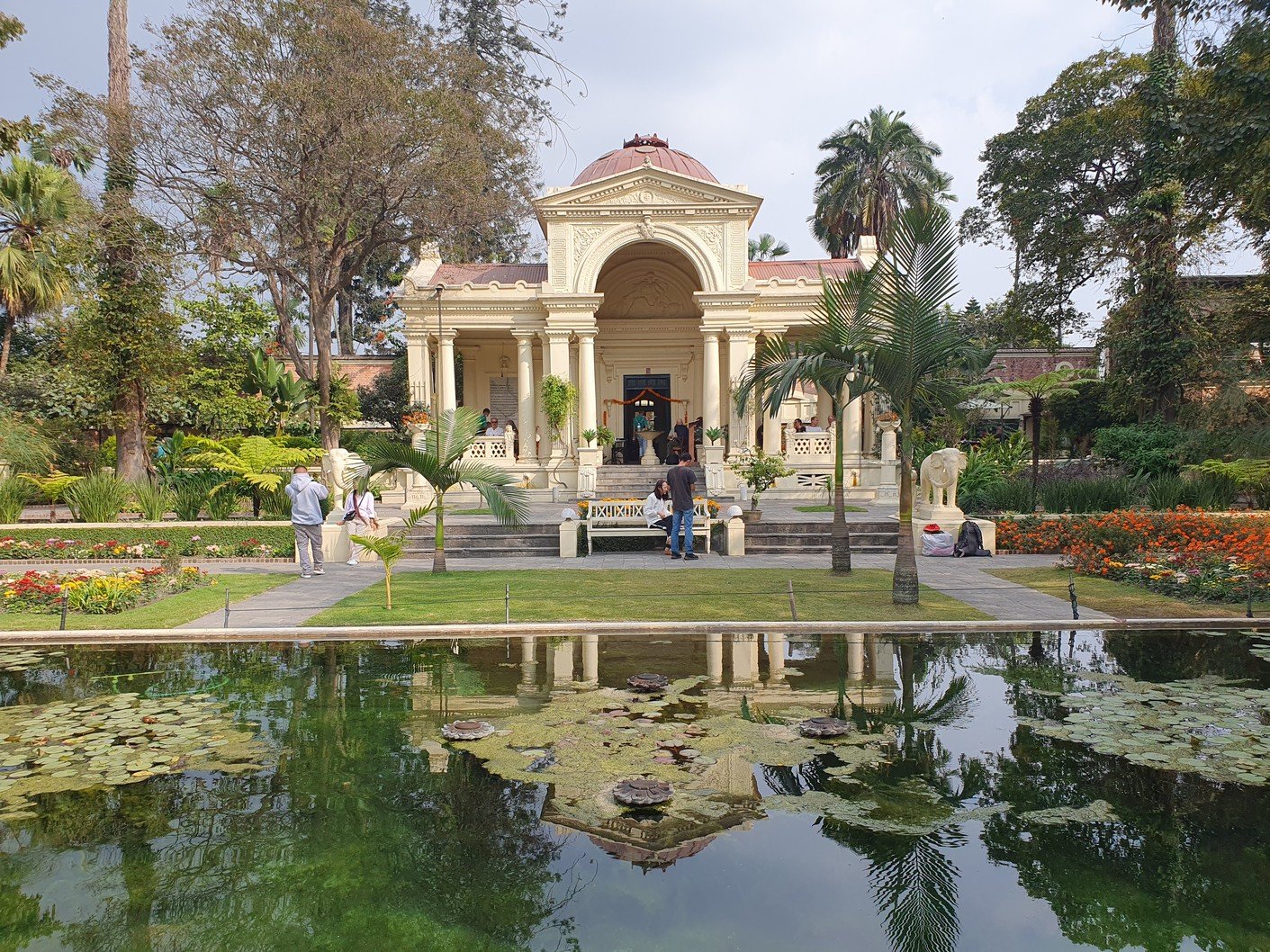
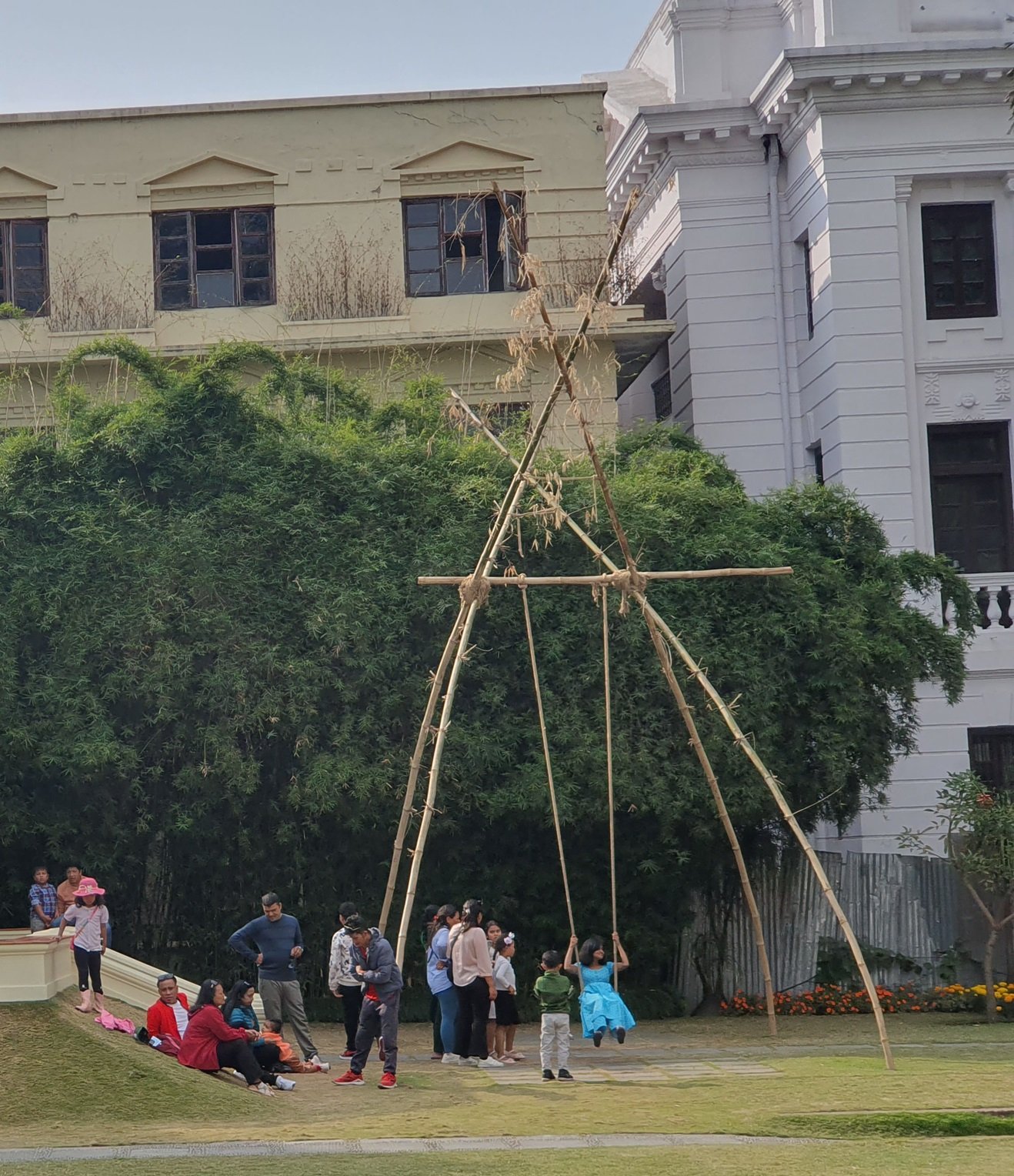
As we had already been on a cultural tour organised by Mountain Monarch when we arrived in Nepal, we had already seen many of the main sights. During our days off, we visited the last few sights, such as the Durbar temple area and the Garden of Dreams park. Durbar is not a clearly fenced temple area but a few blocks of the city south of Thamel. There are ticket booths on the main roads, staffed by hawk-eyed personnel preying on tourists approaching the area and selling them day tickets. For some reason they spotted me and Pude, even though we blended in almost perfectly. The ticket was 1000 rupees per person.
Durbar square
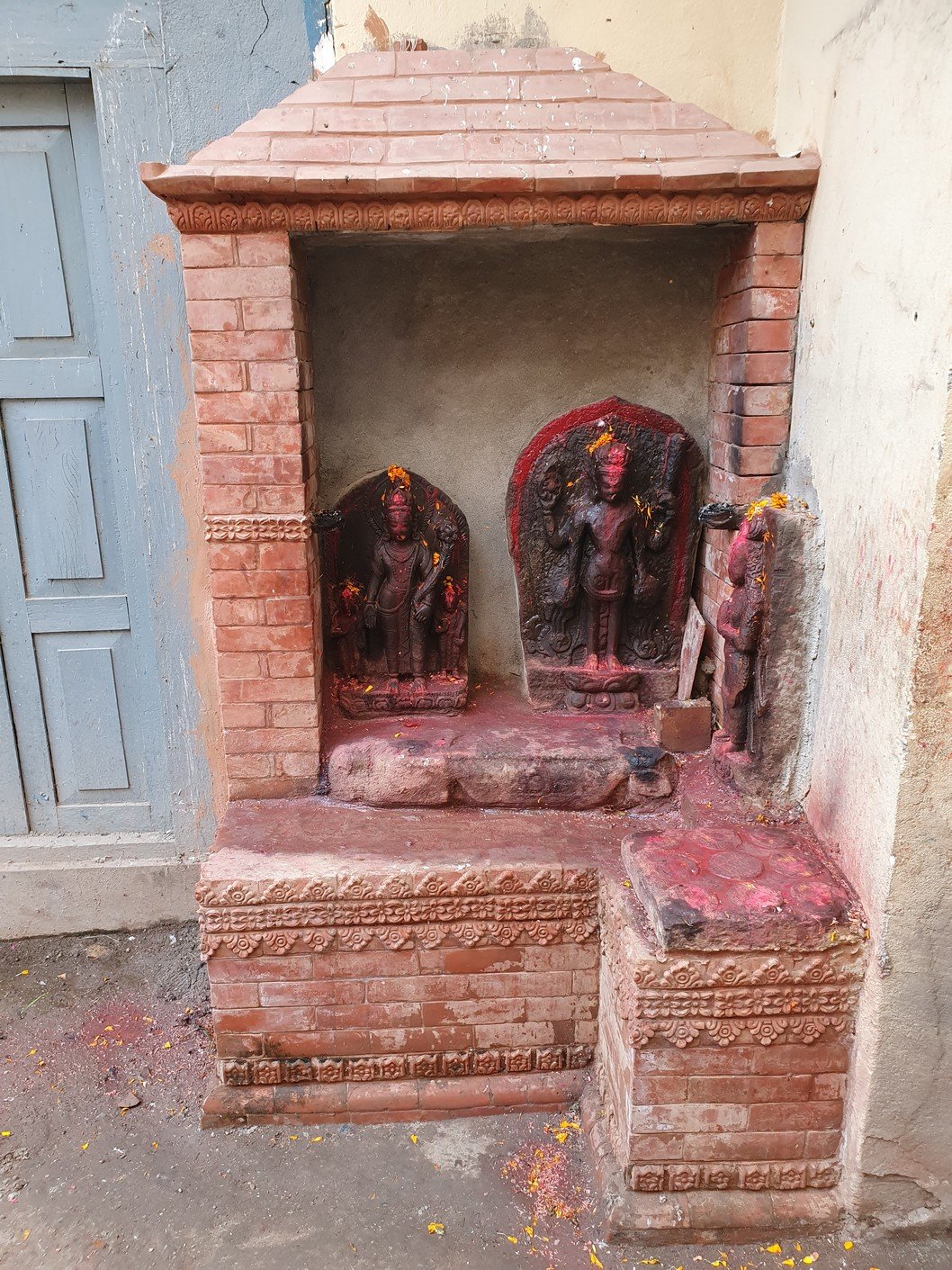
Neighborhood shrine
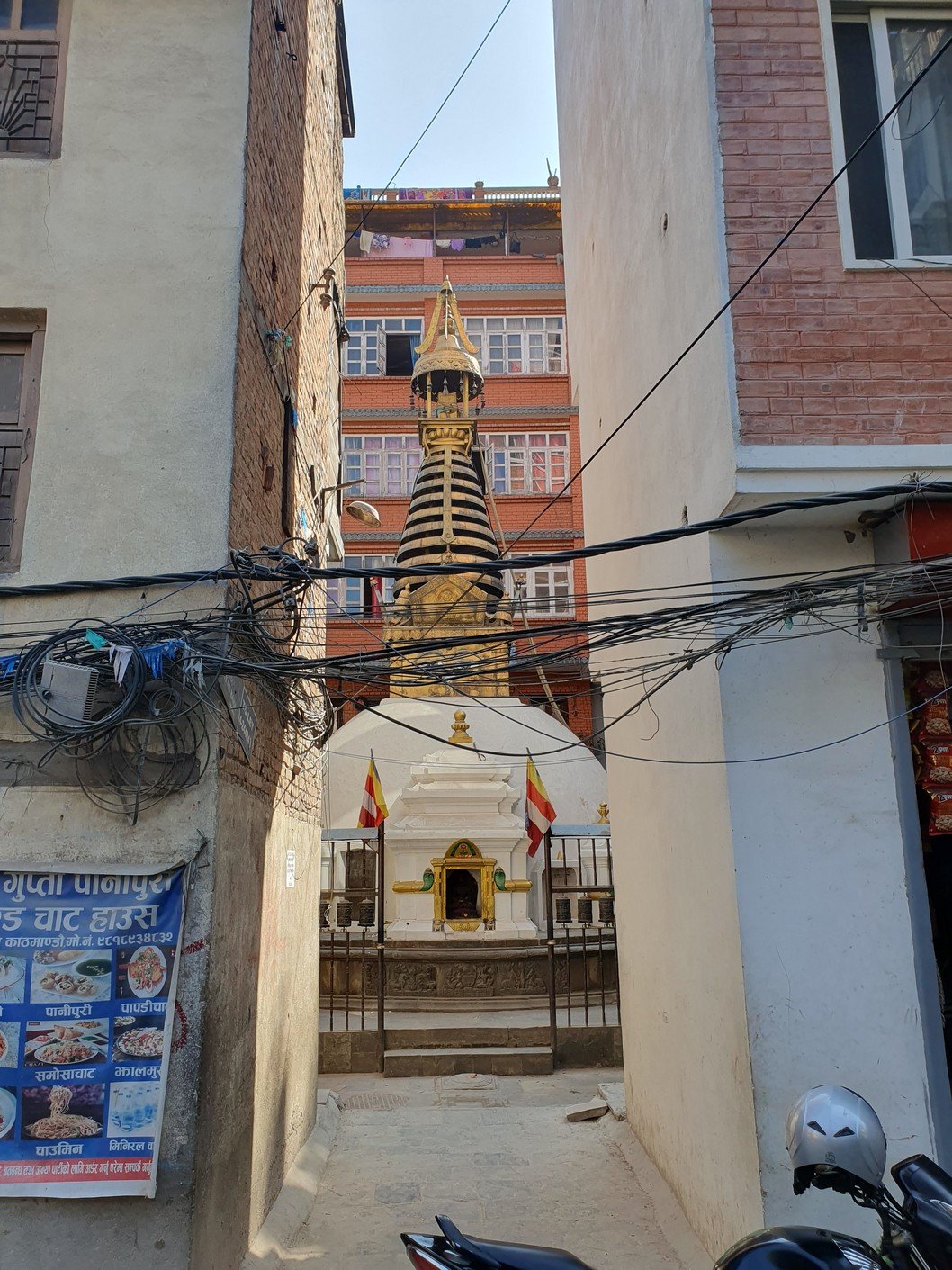
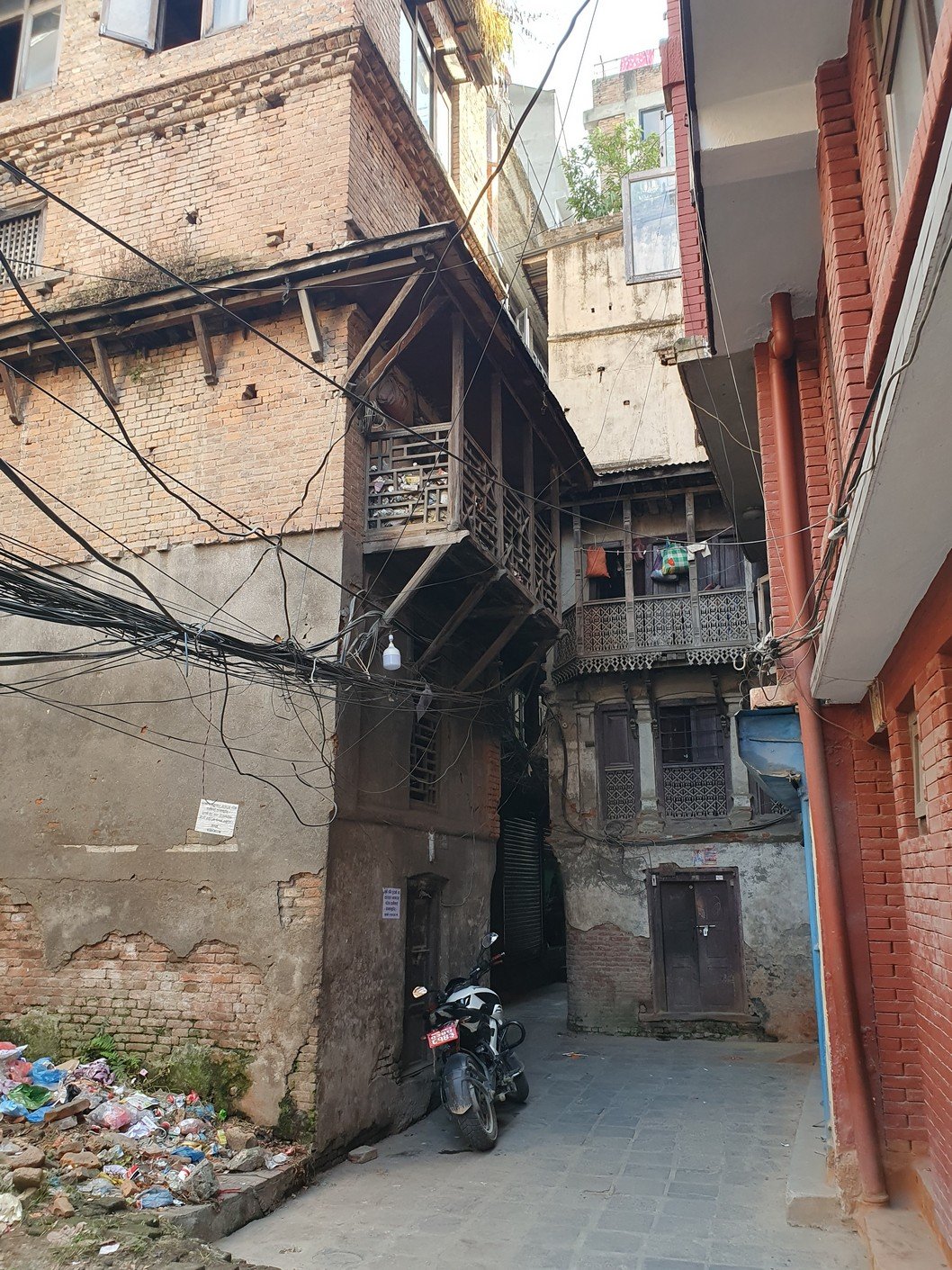
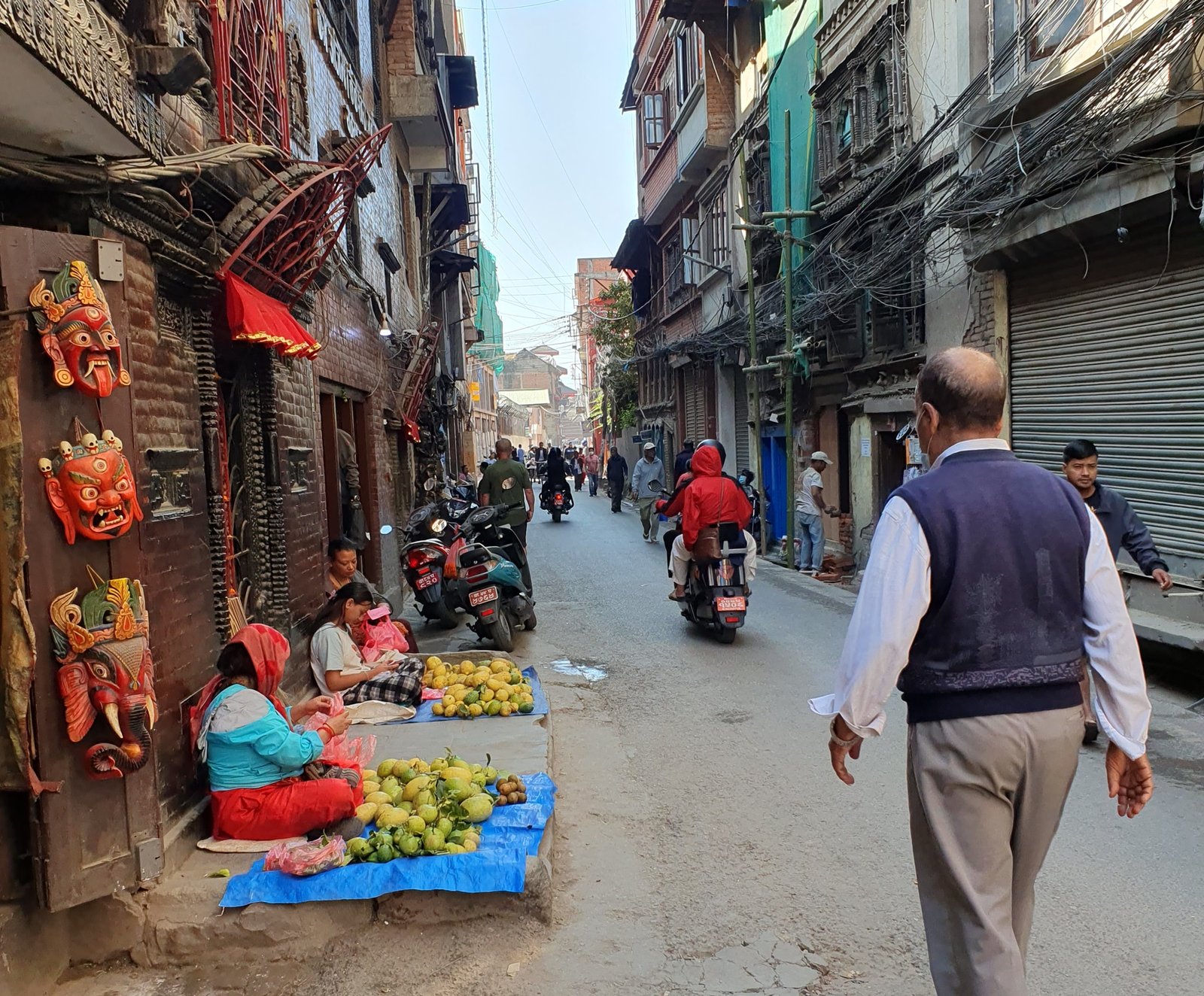
With the exception of a few temples, the Durbar area was a normal part of the city center
Kitchen knives department
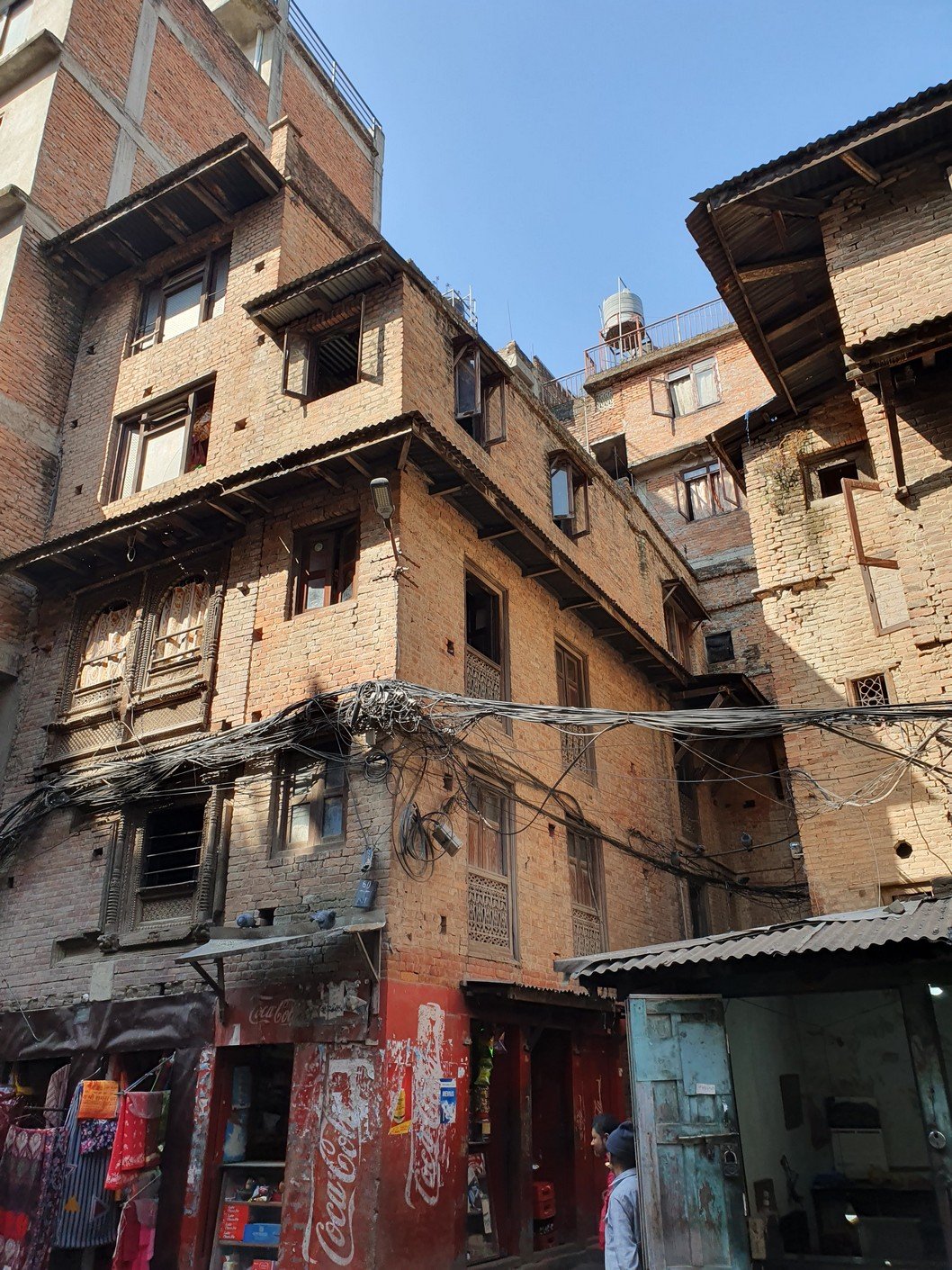
'A renovator's dream property'
Not for car owners
Not for people with reduced mobility
Not for persons over 150 cm
Garden of Dreams
Garden of Dreams
The guard's chair can be seen on the right-hand side. Tourists are unlikely to disturb the mandalas. Since mandalas are everywhere during the festival, even children know not to touch them. The guard's main role is apparently to chase away the chipmunks, who are abundantly scurrying around the park.
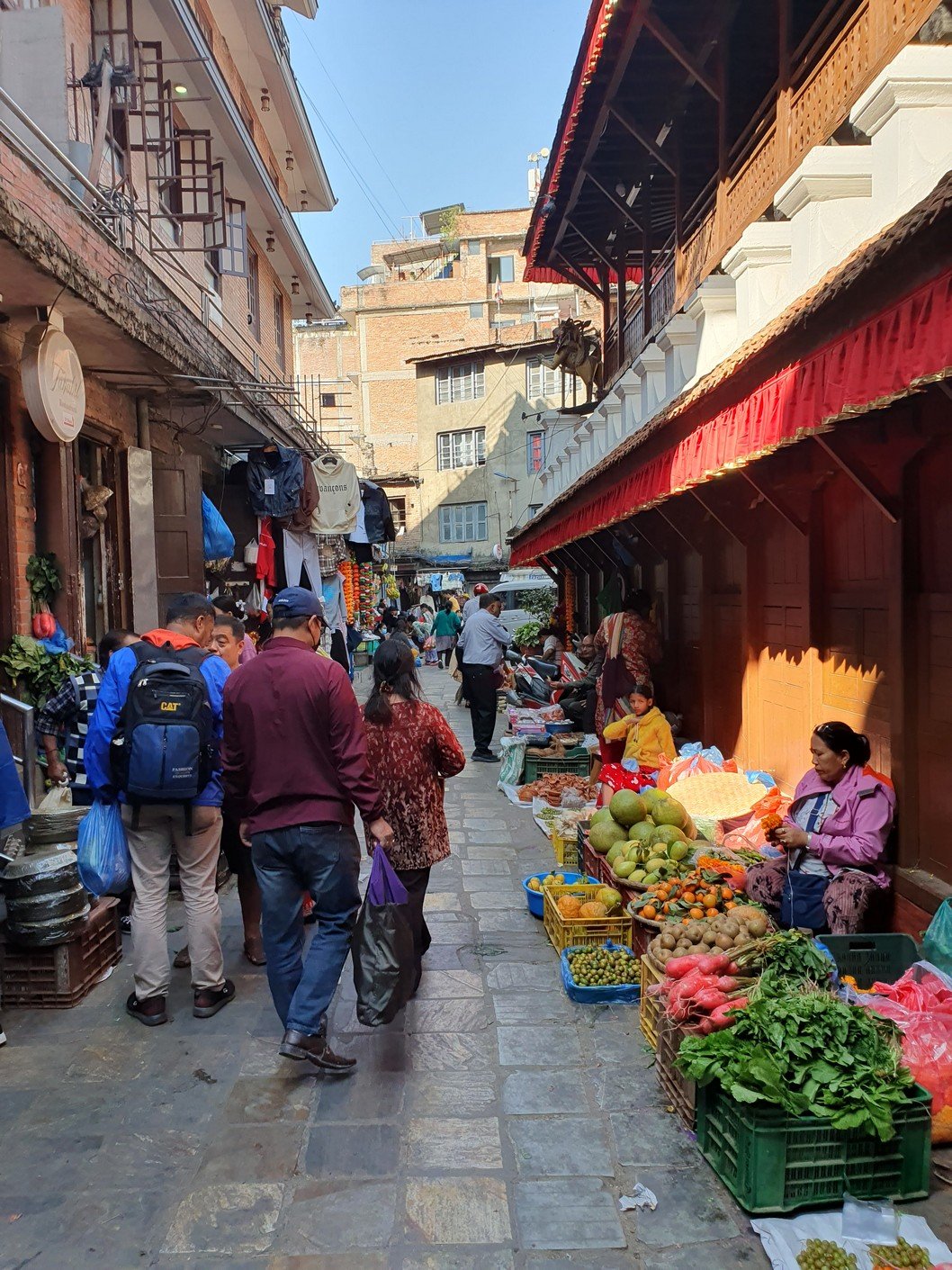
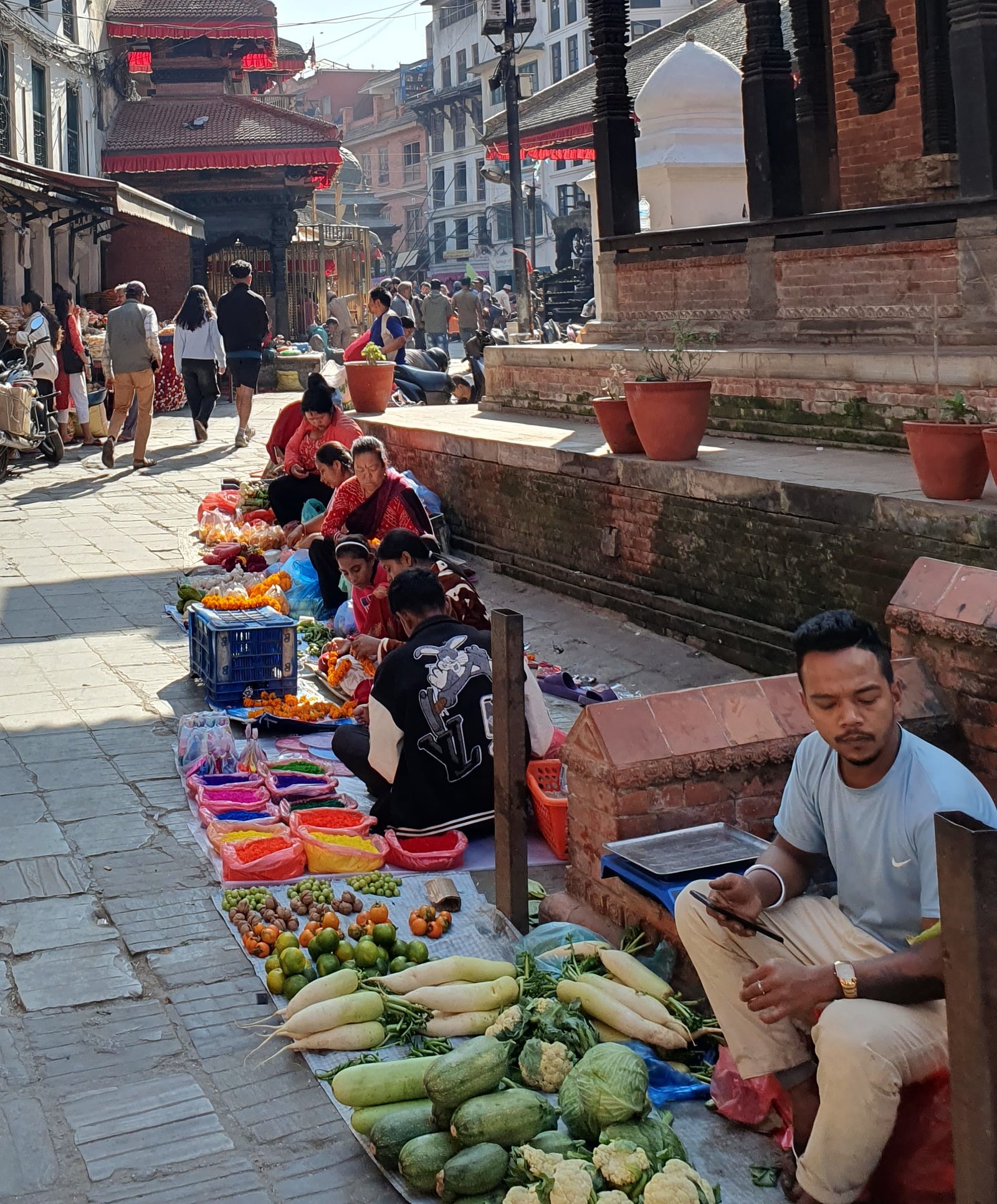
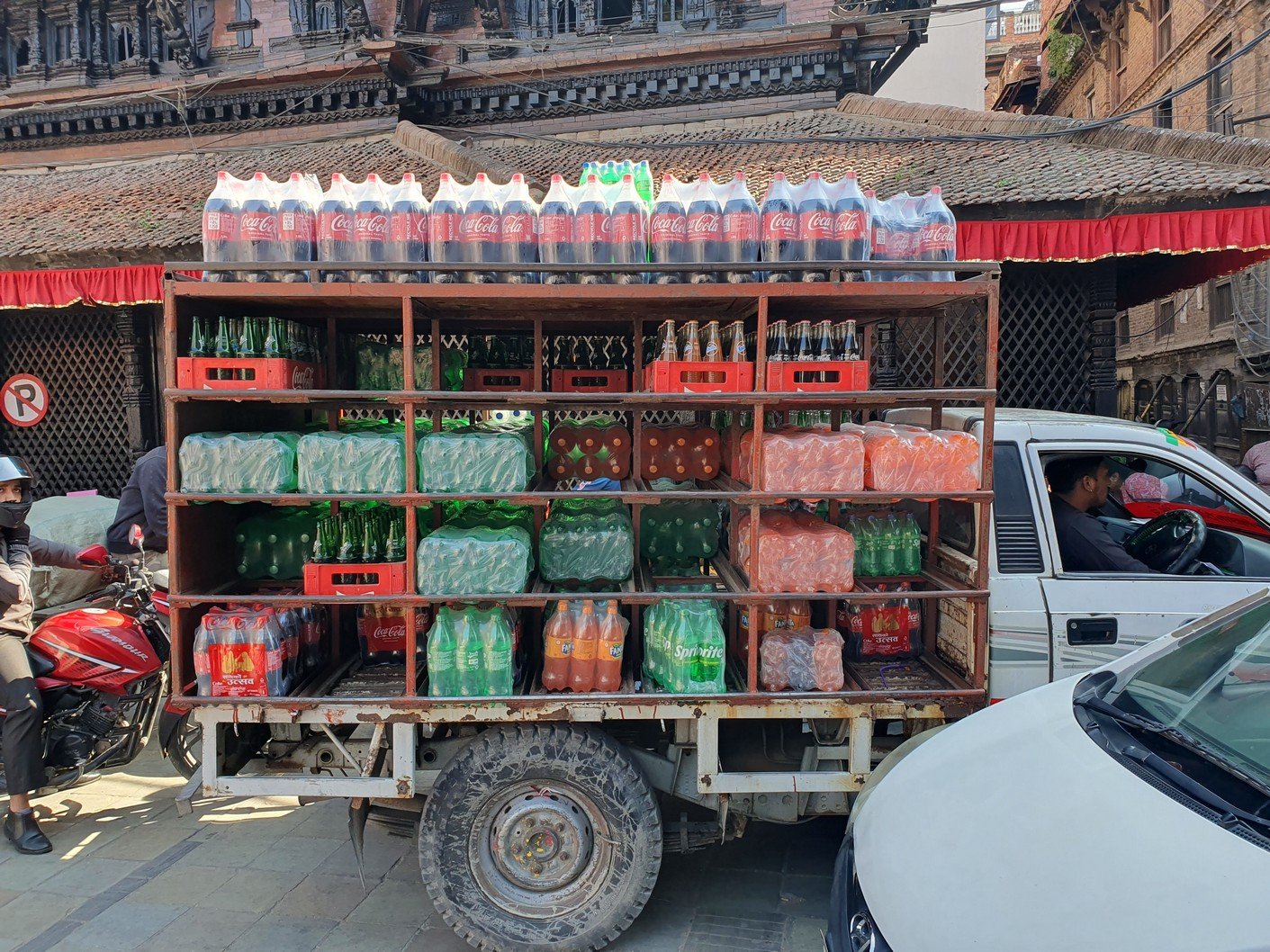
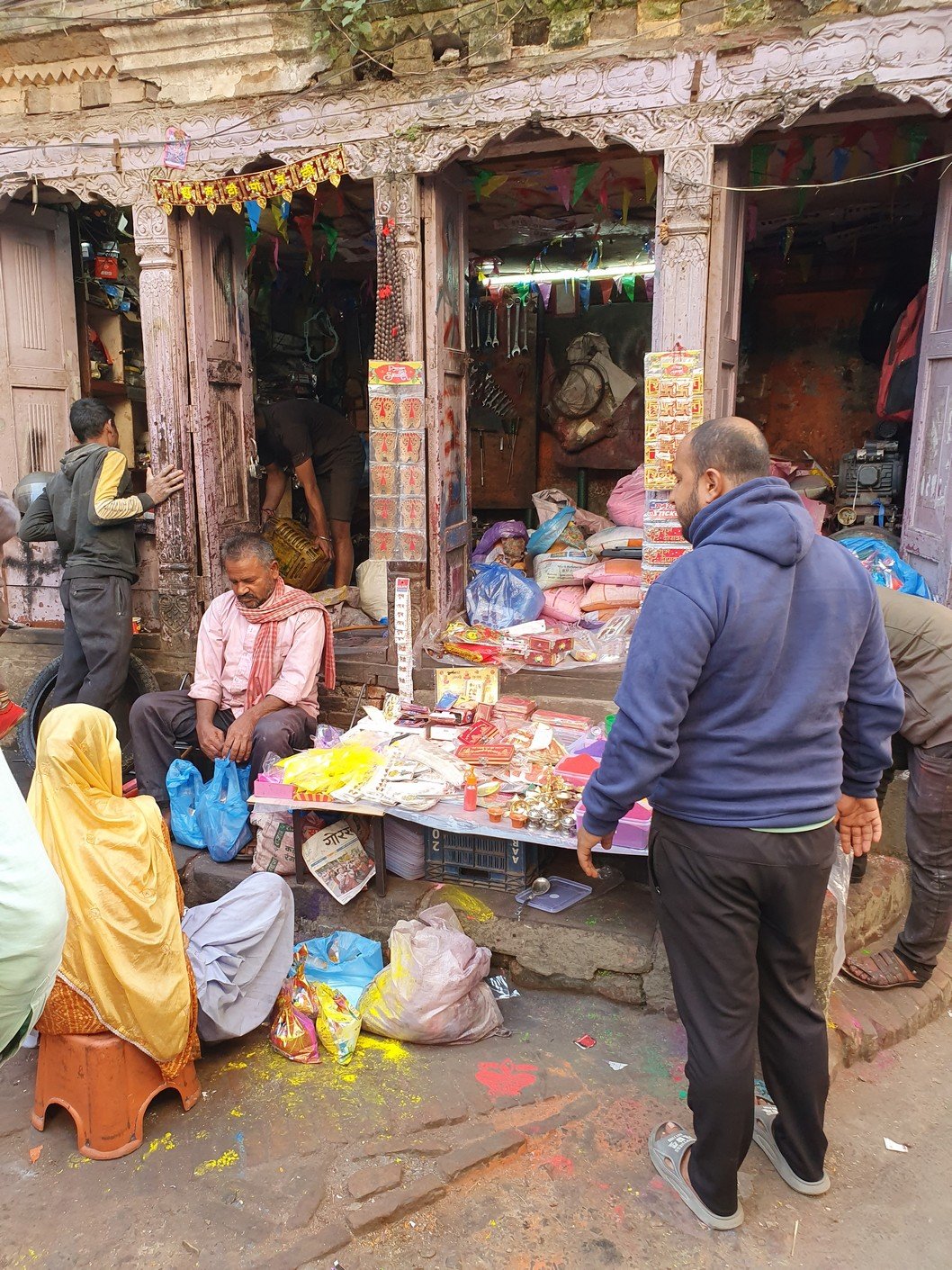
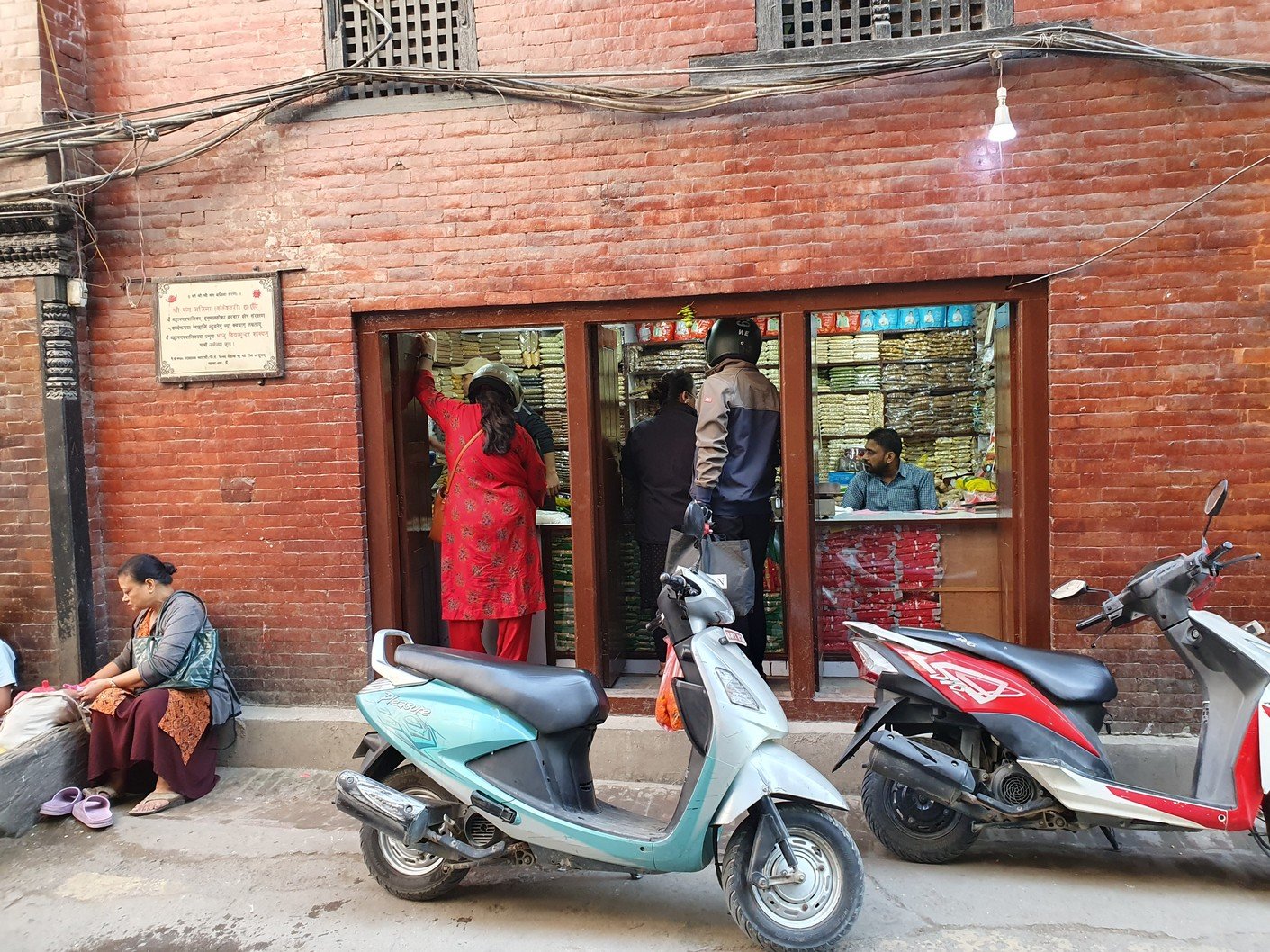
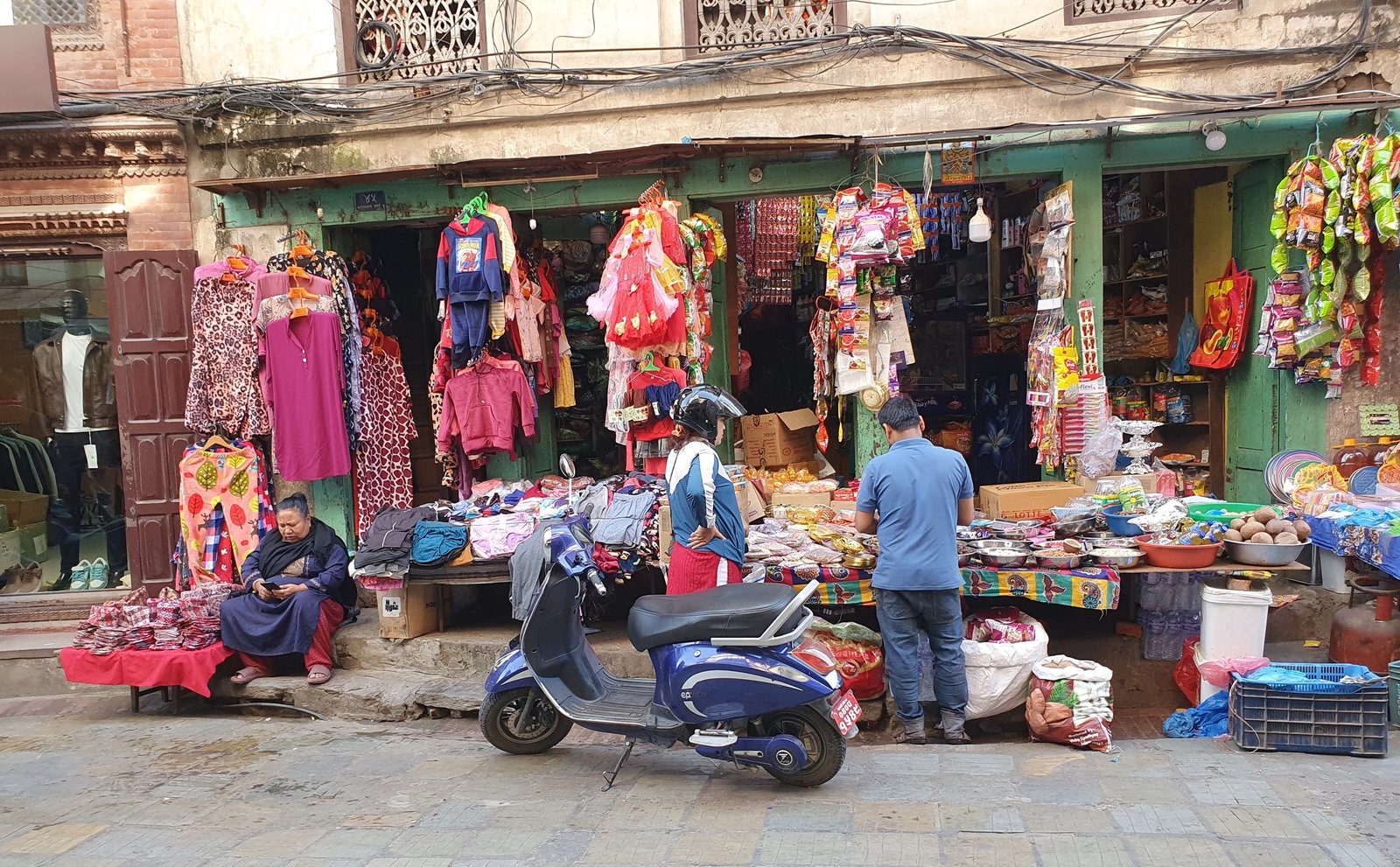
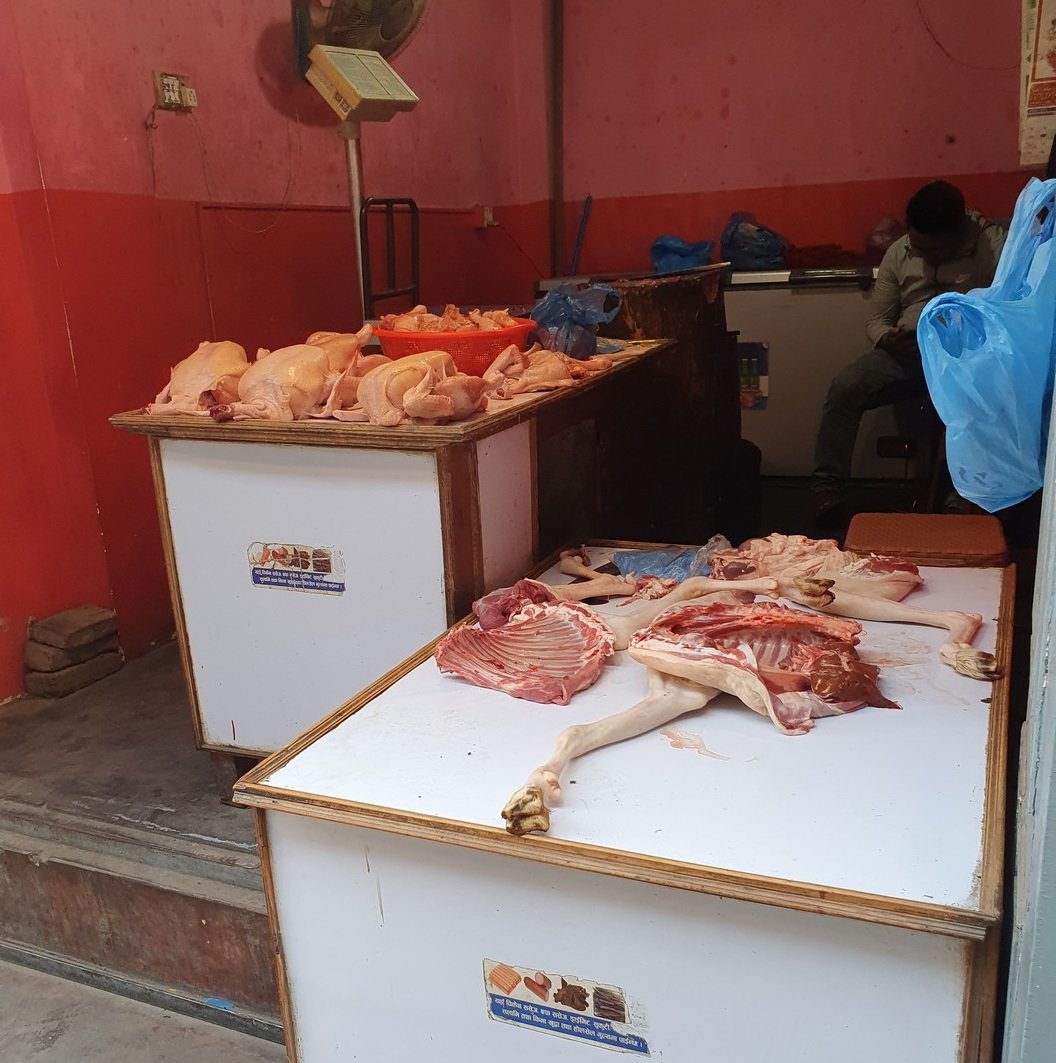
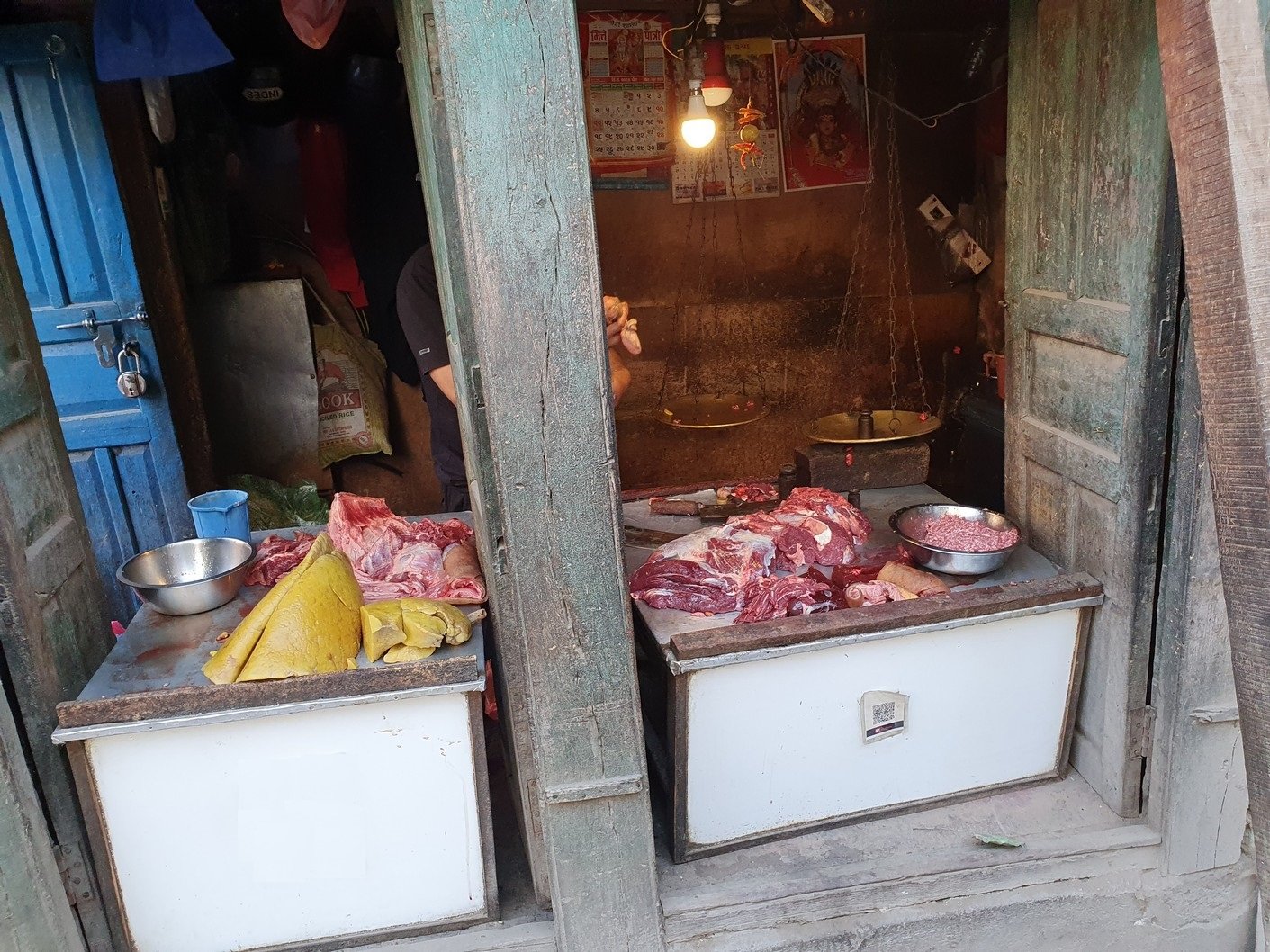
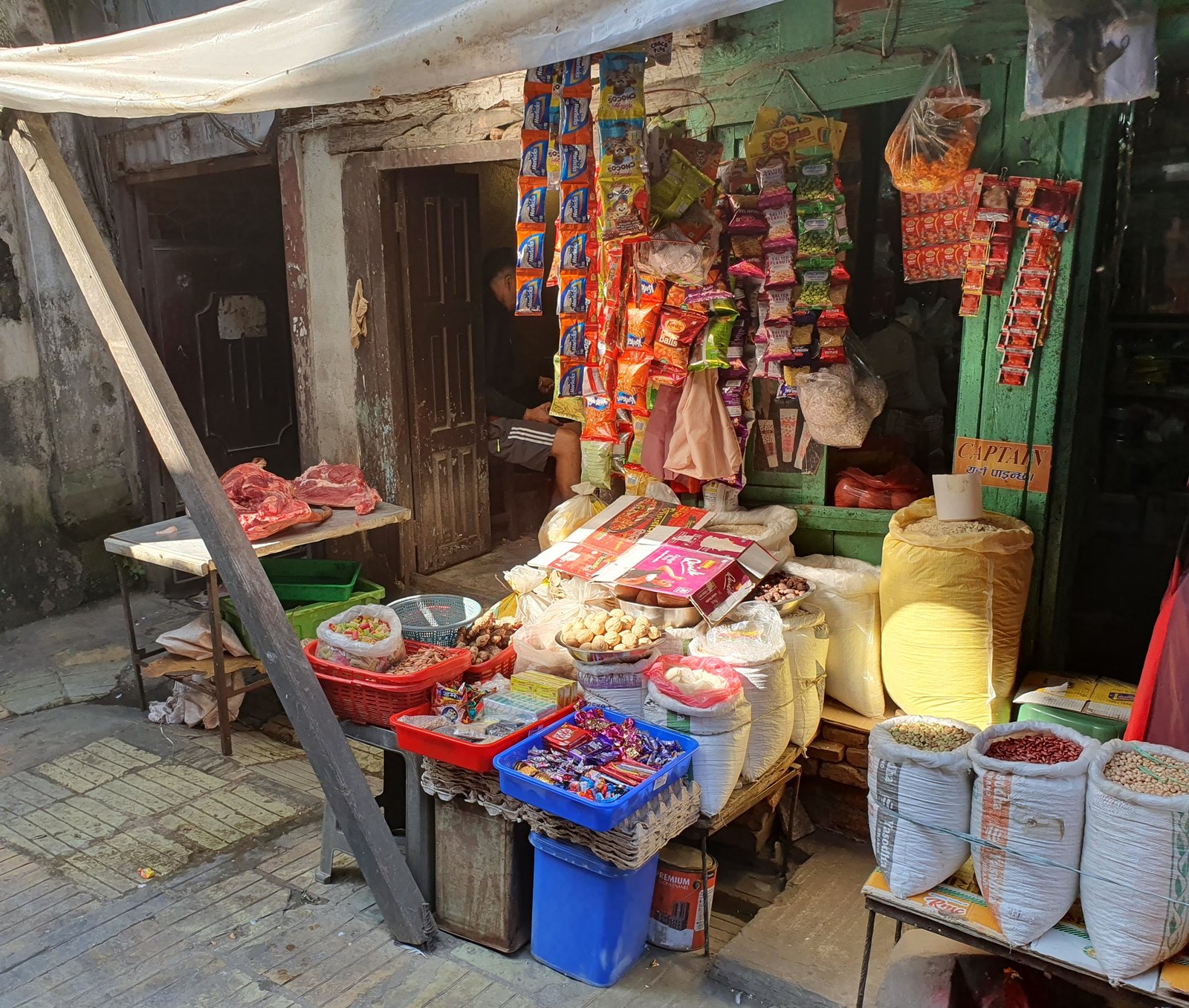
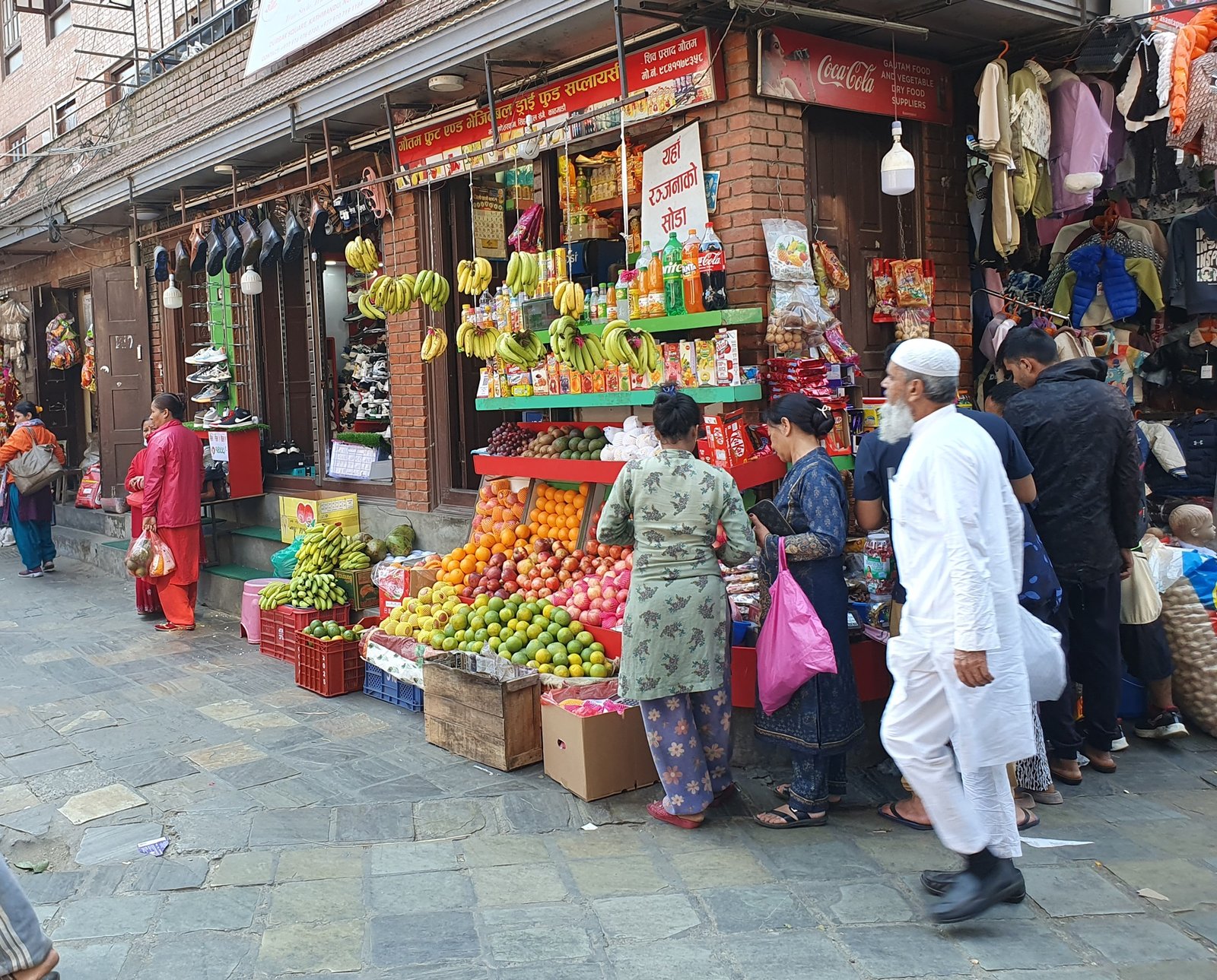
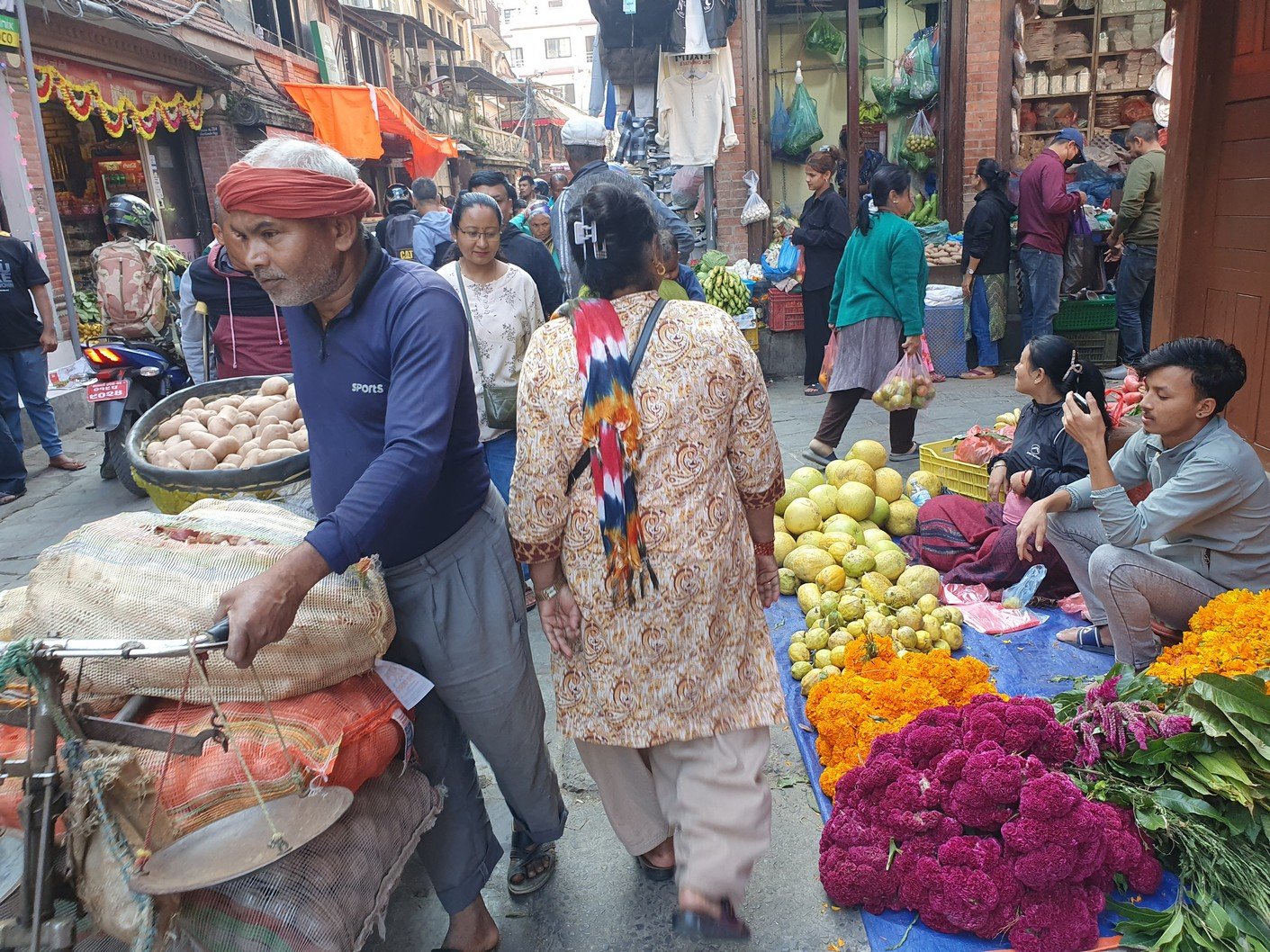
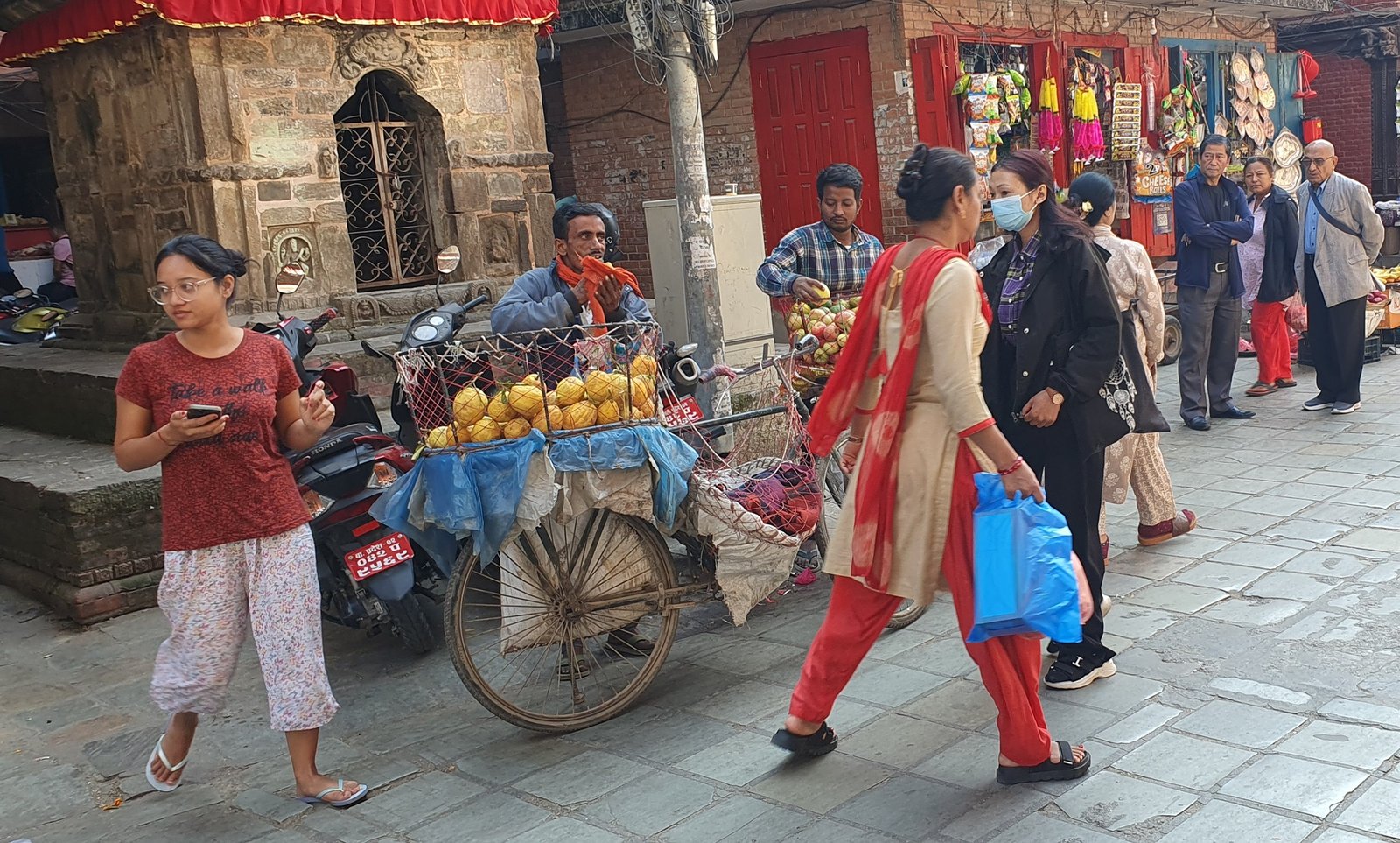
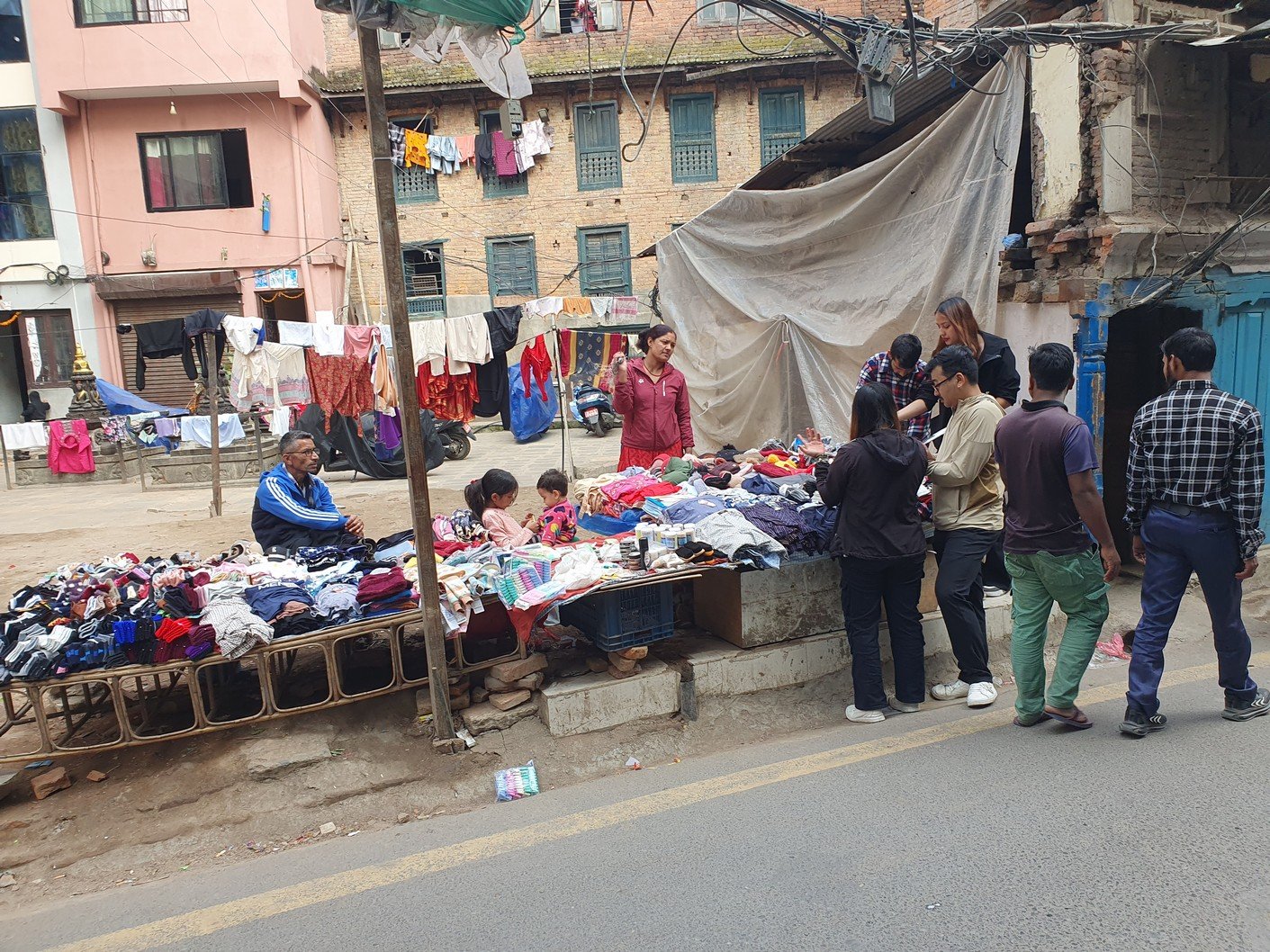
The population of Kathmandu is estimated as anything between 845 000 and 1.6 million, depending presumably on how large an area is counted as Kathmandu. In any case, it is a large and populous city, which became clear already when looking out of the airplane window on arrival. There are no supermarkets or larger speciality stores, and everything is based on small shops, stalls and street vendors. The small size of the outlets is compensated by their massive number.
The Thamel area is full of trekking-related shops
Large neighborhood market
A stall with liquour rights. In reality, I don't think the Nepali language even includes words like 'licence'.
Thamel region - express delivery option not available
Judging by the queue, there was something nice available here
One-stop tactics - moped repair and festival needs
Meat shops were plentiful
Cold chain - translation not found
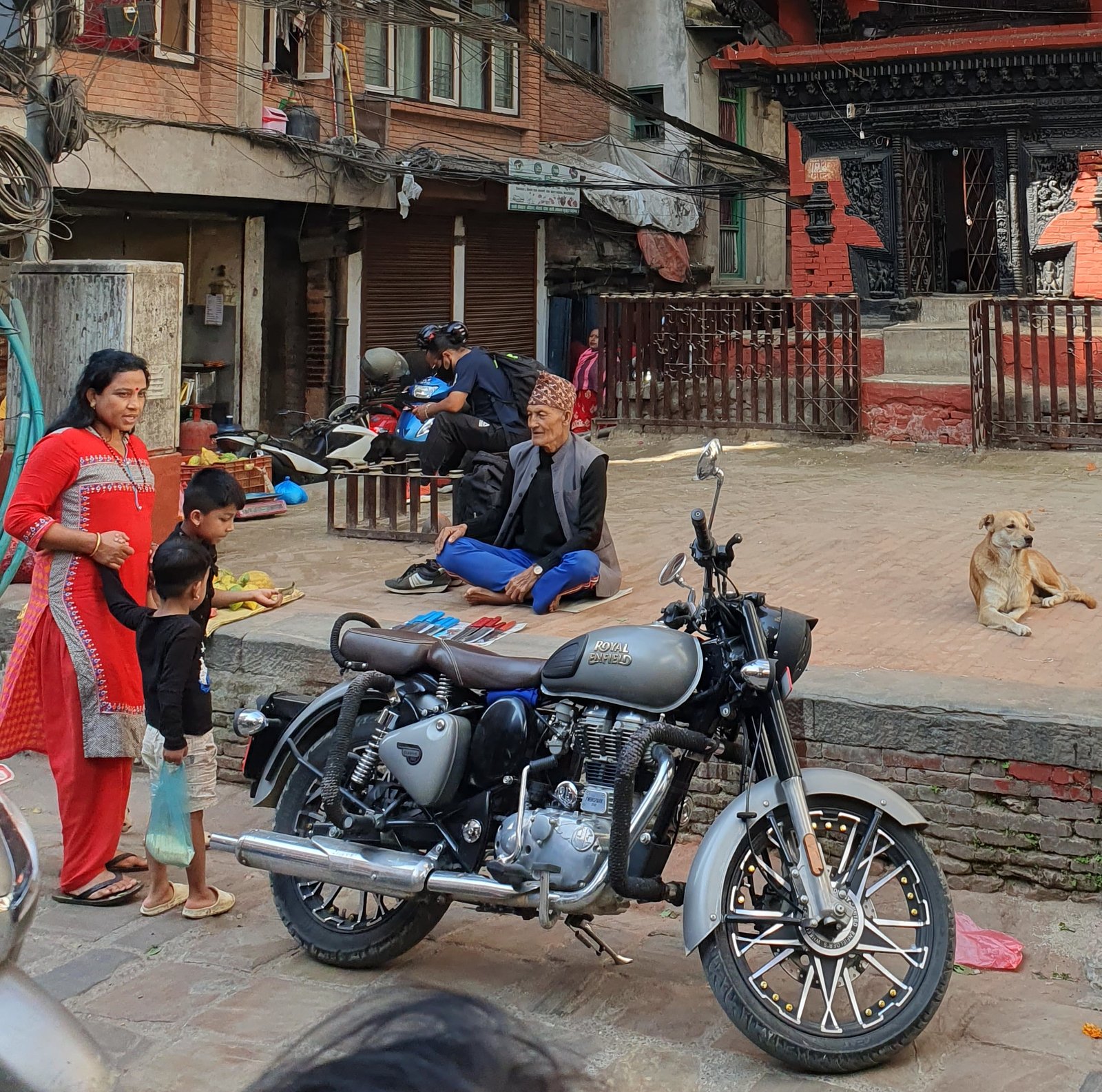
If you can get the whole family on a scooter, you can get one station wagon worth of stuff on a bike too.
Nepal's version of a pop-up shop
I'm thinking the vegetables need a wash before use
Prayer flags and incense
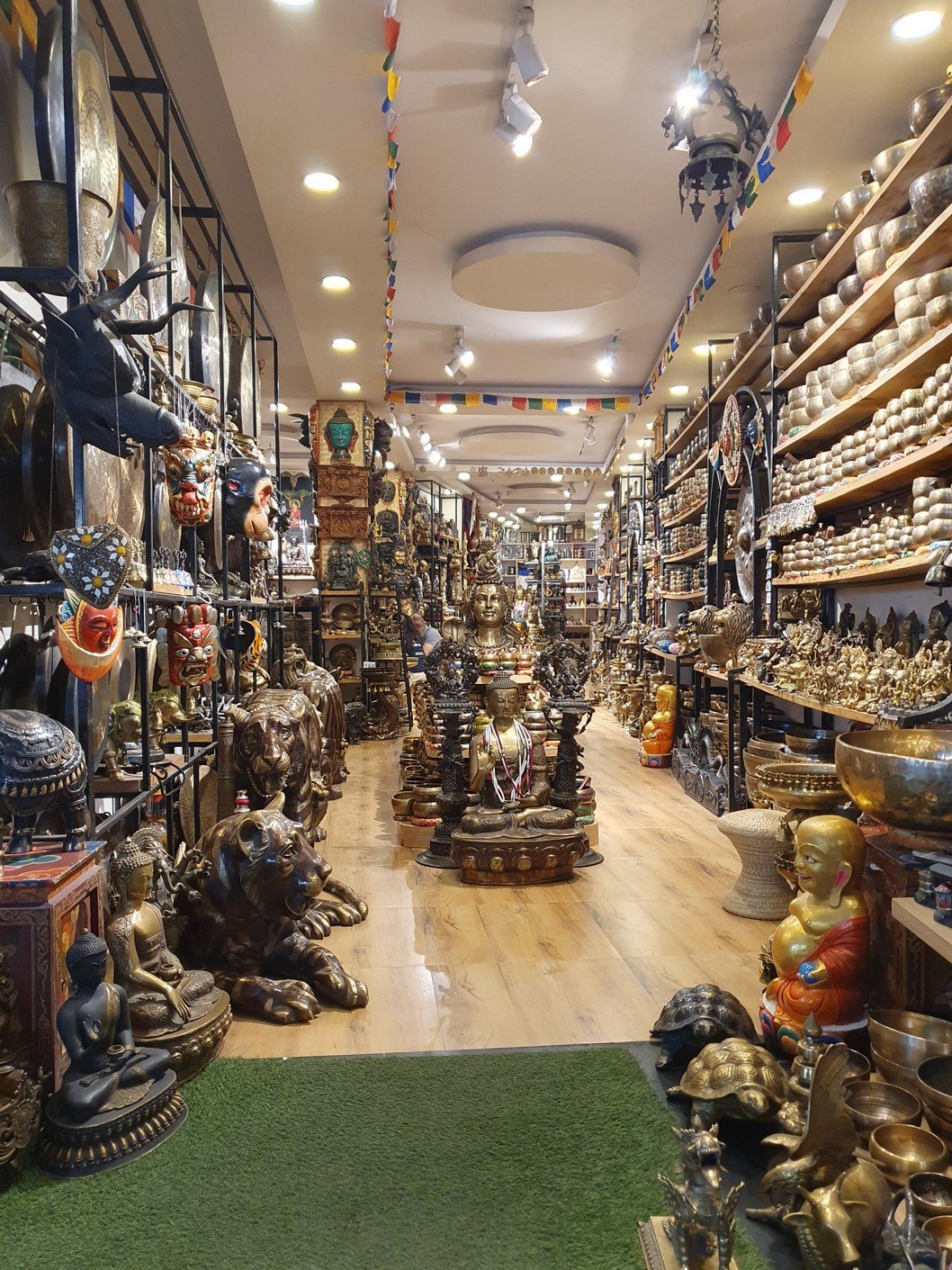
Religious-themed trinkets were abundantly available
Teenage girls' heaven
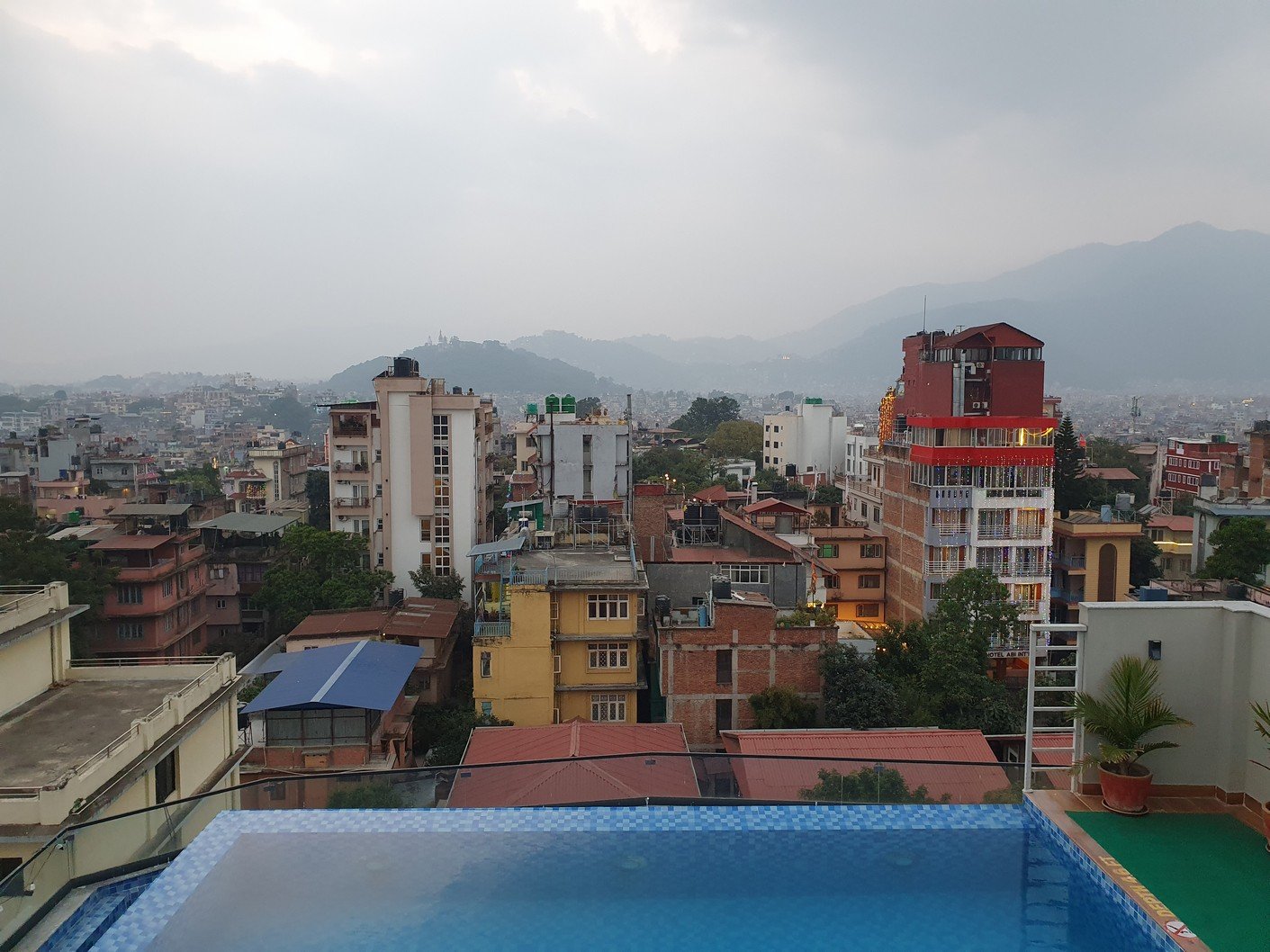
For the last two nights we moved back to the Divine Hotel, also in the Thamel area about half a kilometre from the Harati Inn. Fashionably, the hotel had a rooftop terrace and infinity pool. By early November, the nights were already cool and the water wasn’t very warm anymore. However, the views were good.
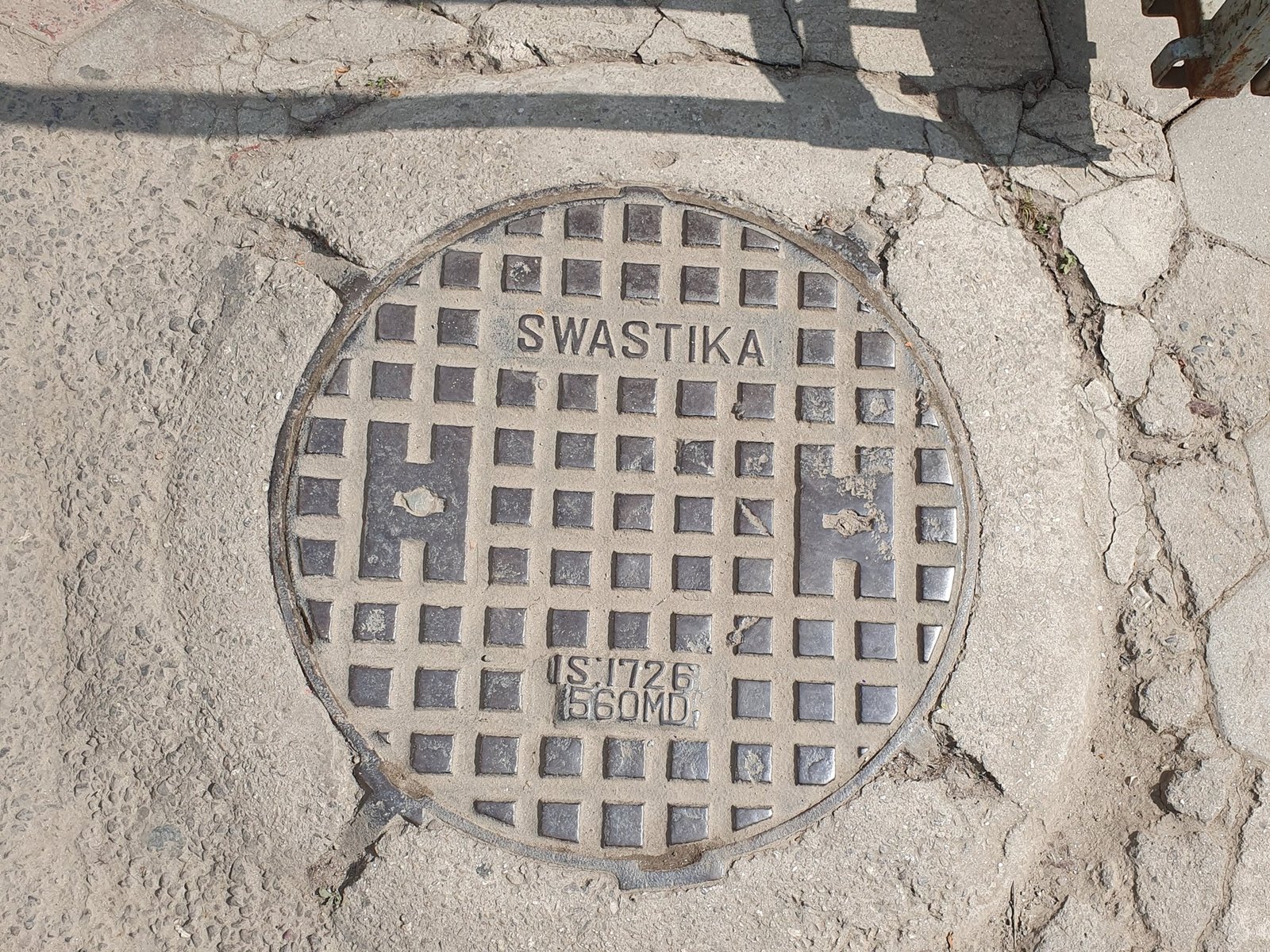
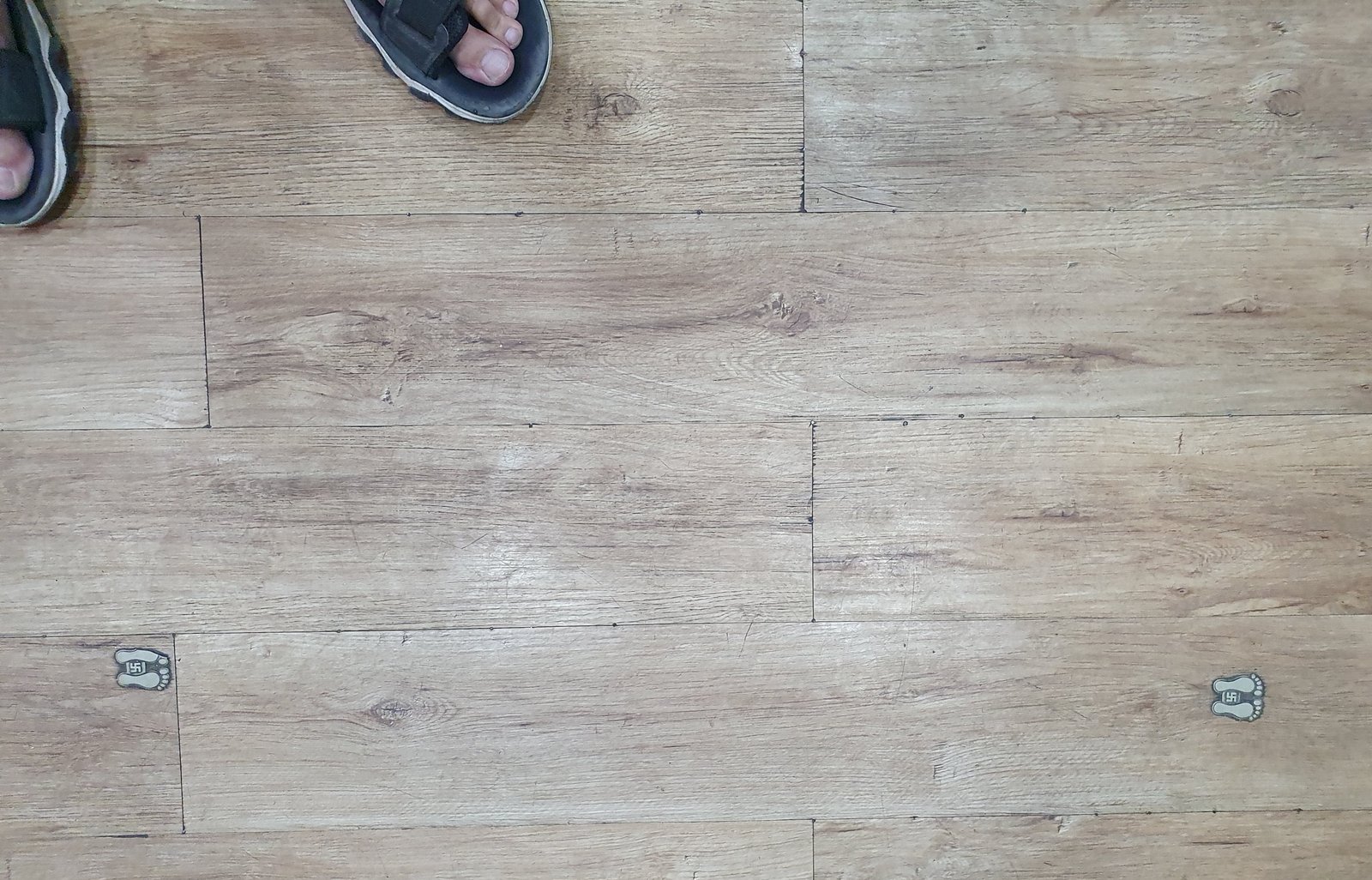
The swastika is originally a Hindu symbol of good luck and prosperity. Apart from the shape of the symbol, the word is also the same. It is still a widely used word and symbol in everyday life, not to mention during festivals. To the European eye, it looks a little odd, with swastikas on every corner.
I wonder what the patent office would think if you tried to register Swastika Ltd, a company specialising in well covers and other metal products.
If the well cover business doesn't work out, you can always try the soybean oil business
There was a strict order in the burrito restaurant. Nazis to line up one meter apart.
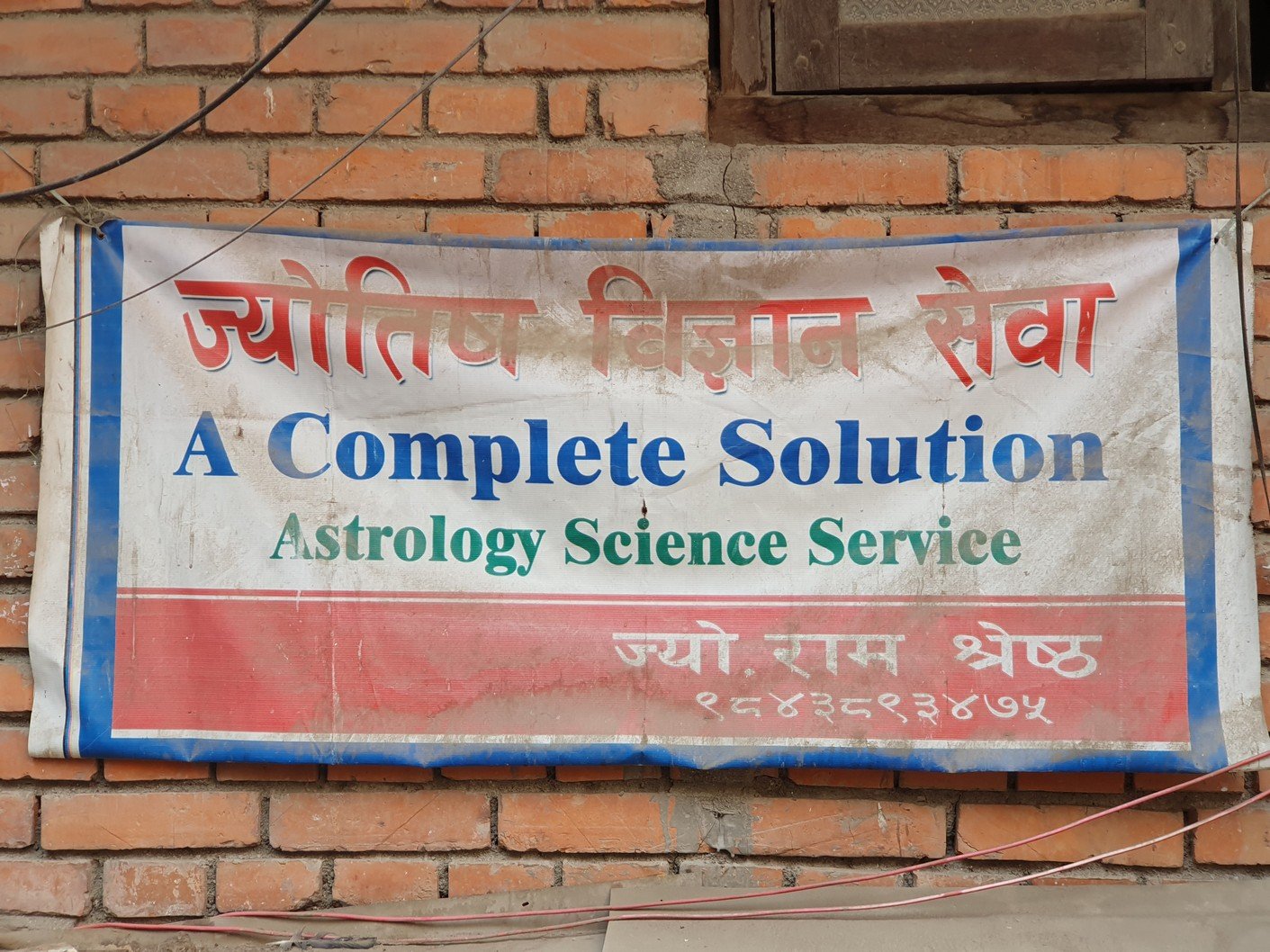
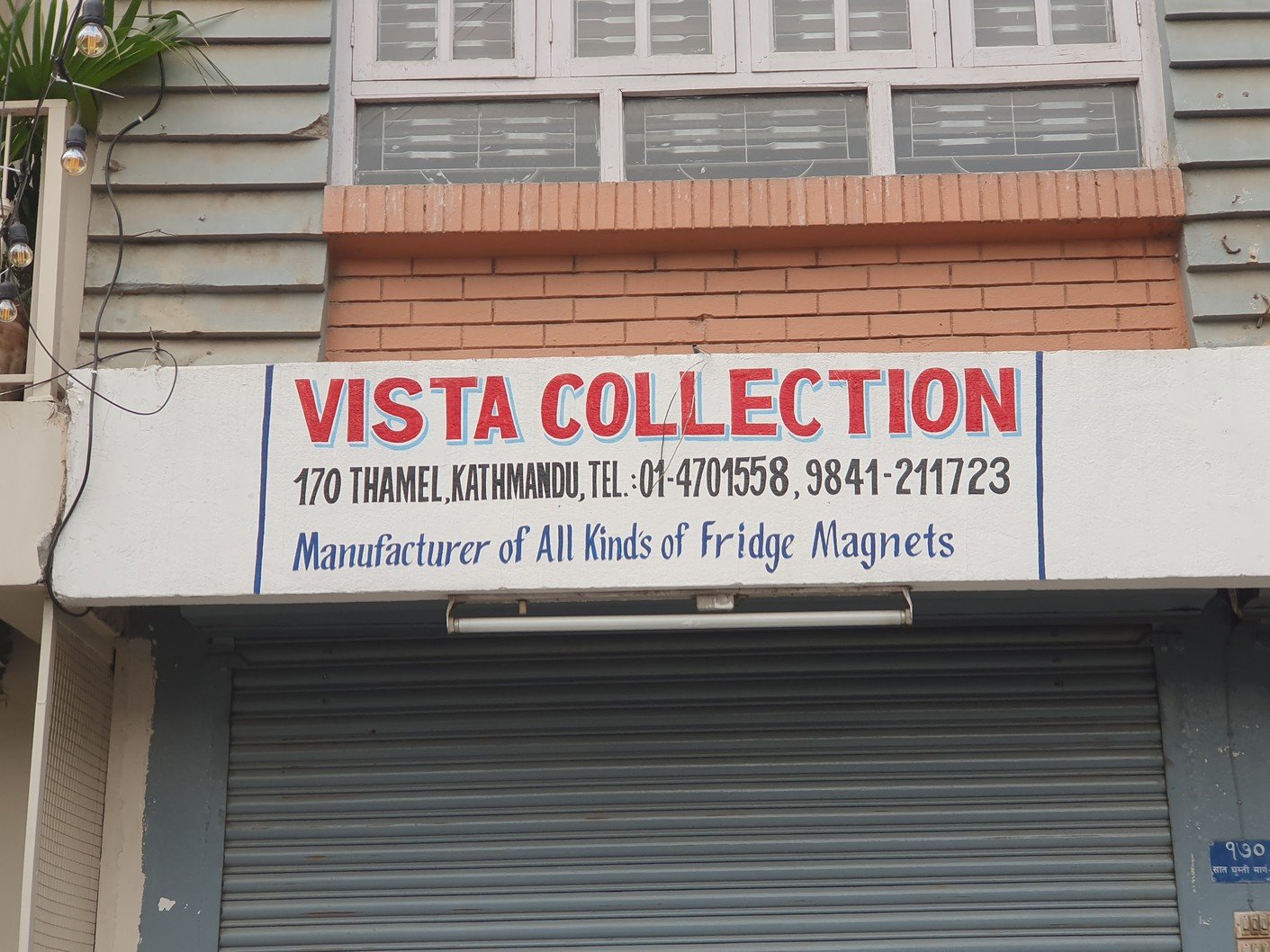
In addition to the countless small shops, Kathmandu also has other interesting entrepreneurial activities.
A complete solution based on astrology. Solution to what?
A fridge magnet business in a country where, by default, people don't even have fridges. Good thinking, Batman!!! It might not be worthwhile to pitch this in one of the western start-up reality shows.
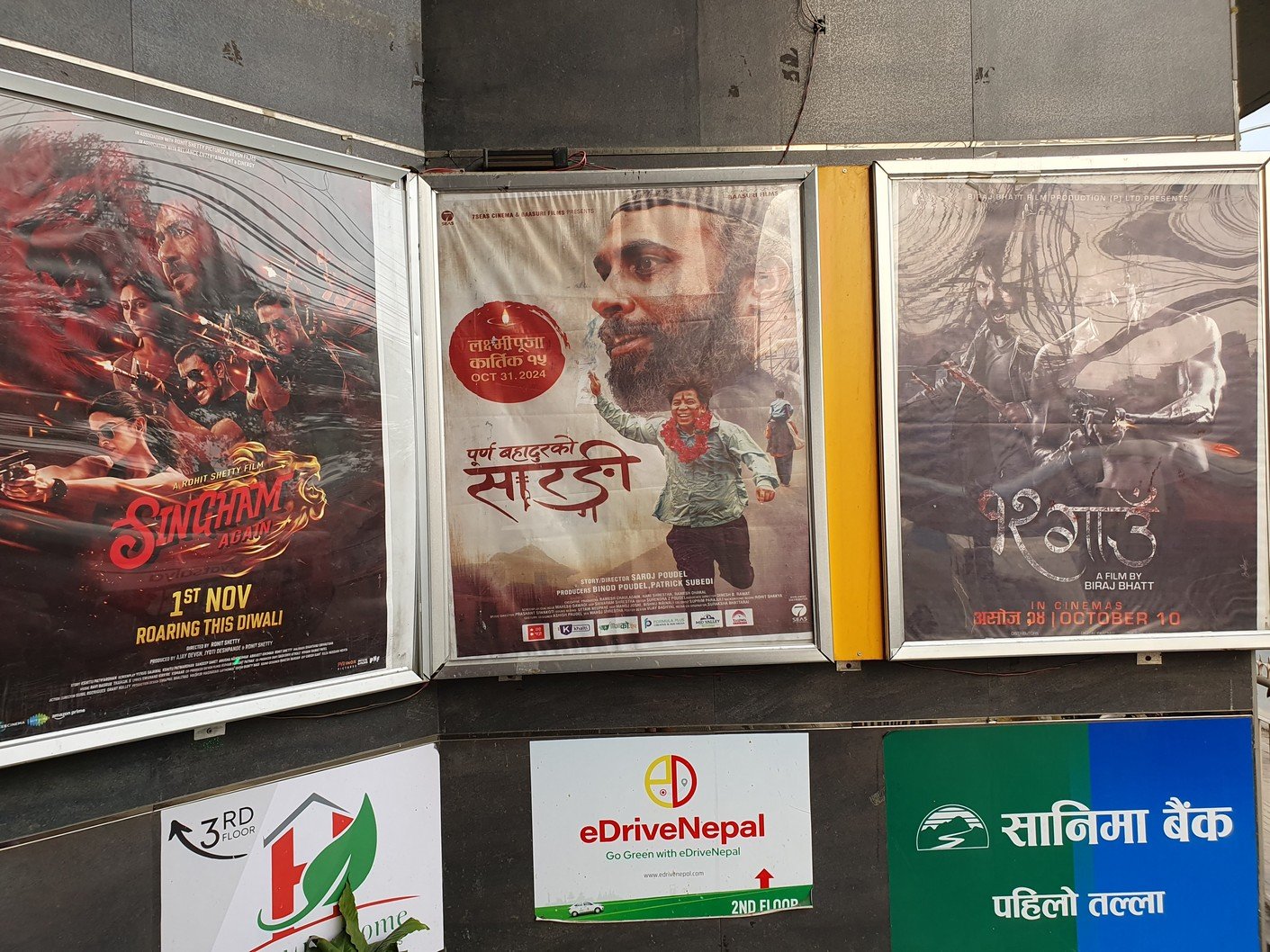
The local cinema is unlikely to profit much from the influx of western tourists
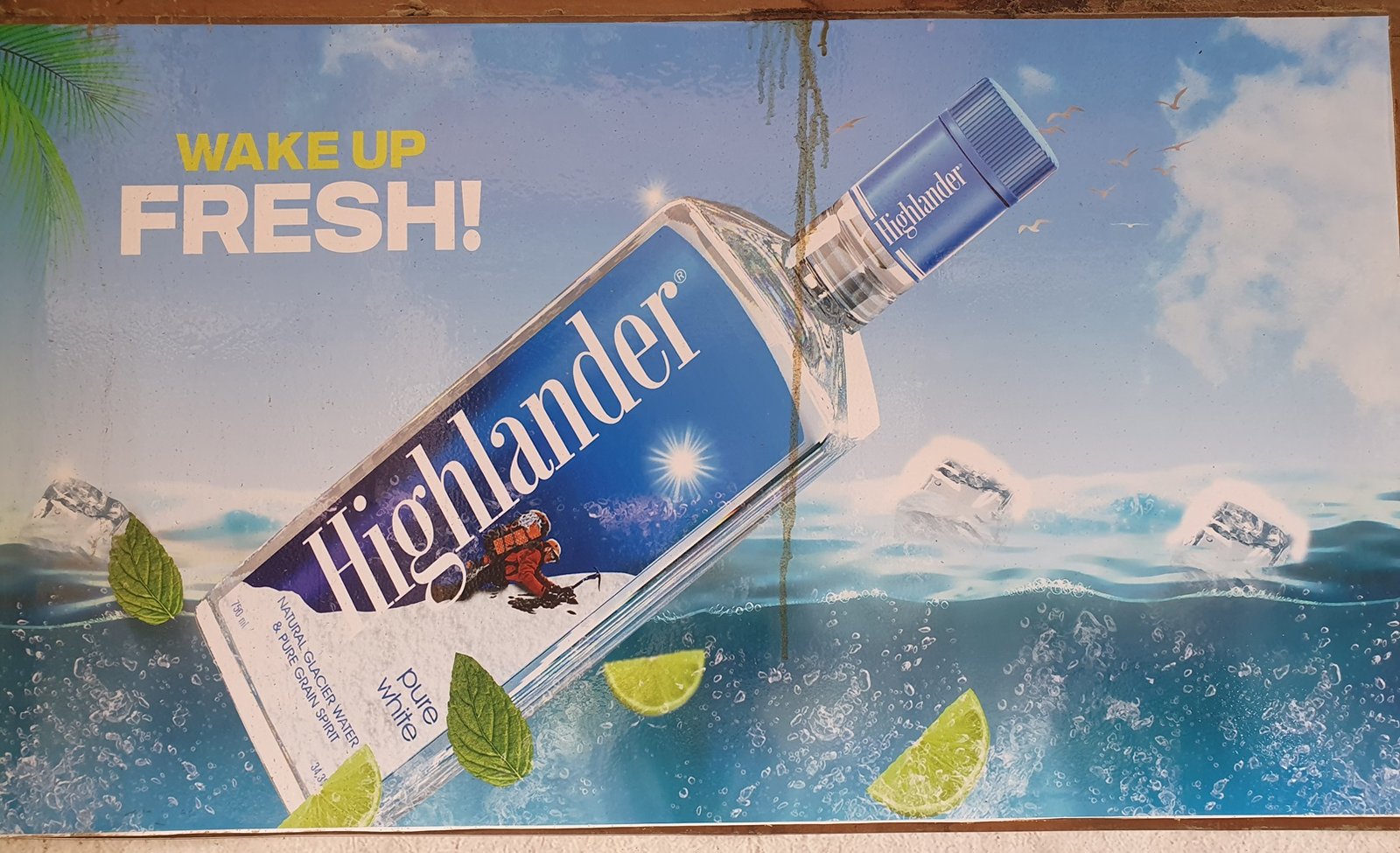
The slogan of a booze advert: Wake up fresh! WTF?!?
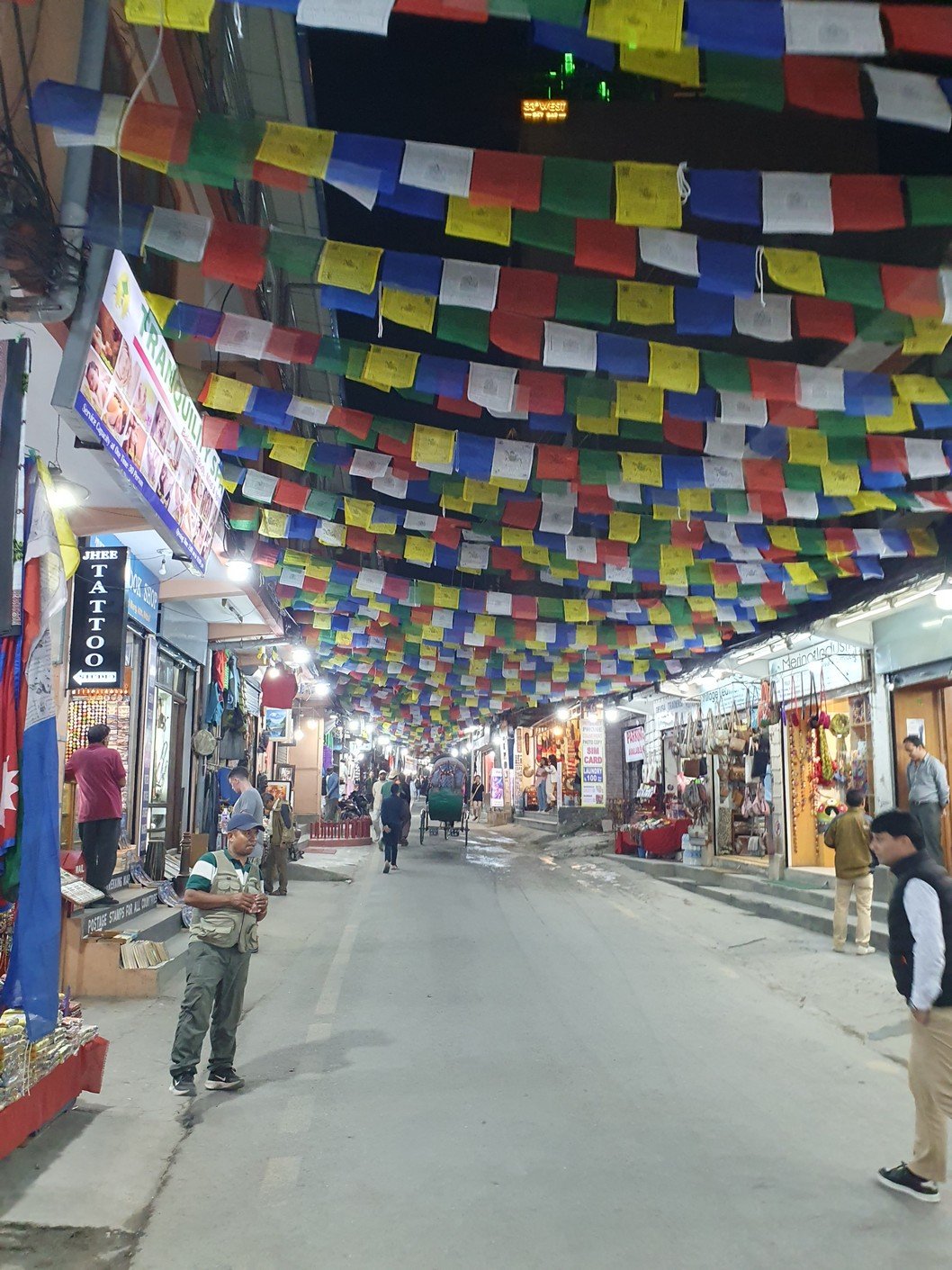
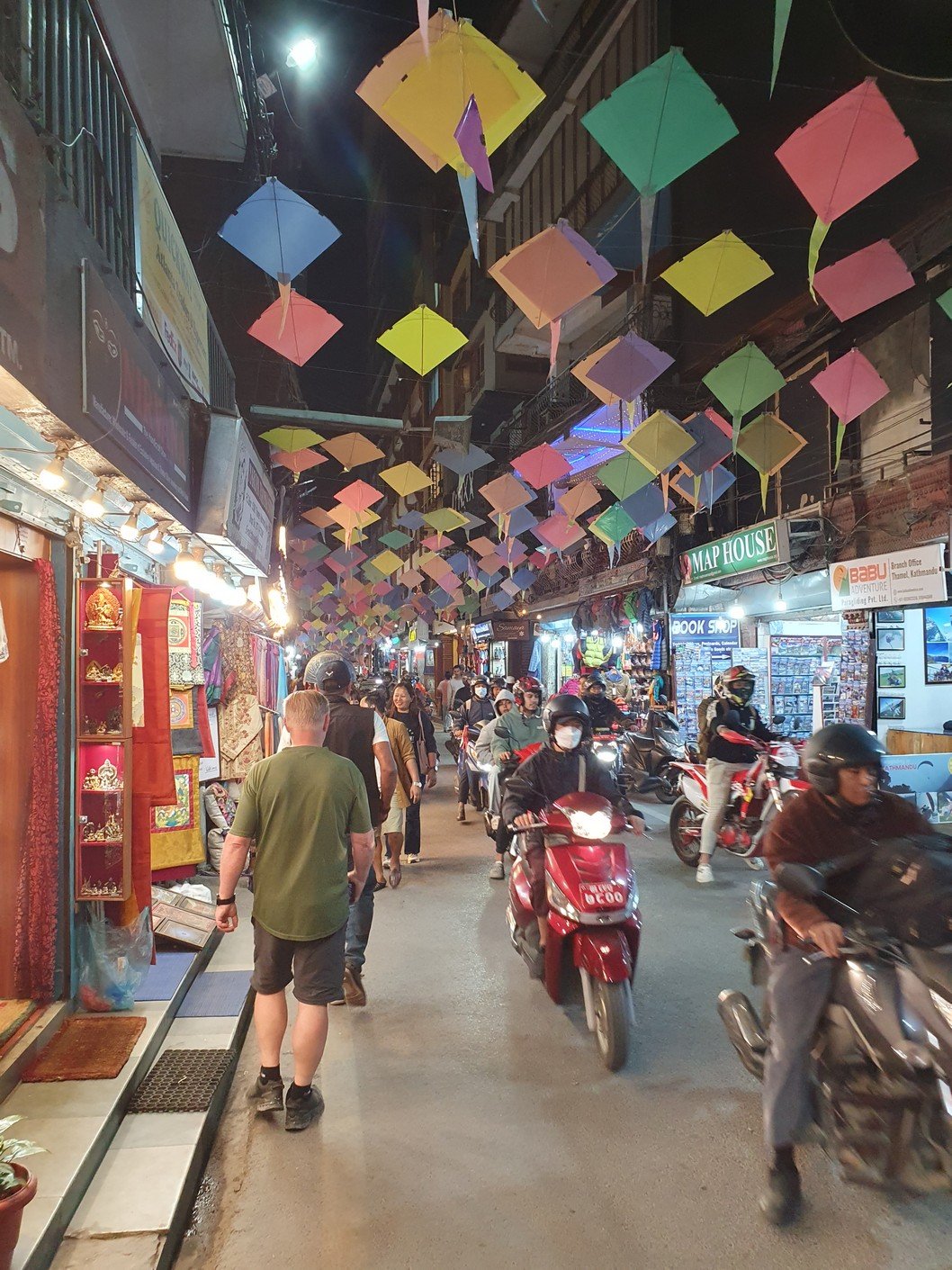
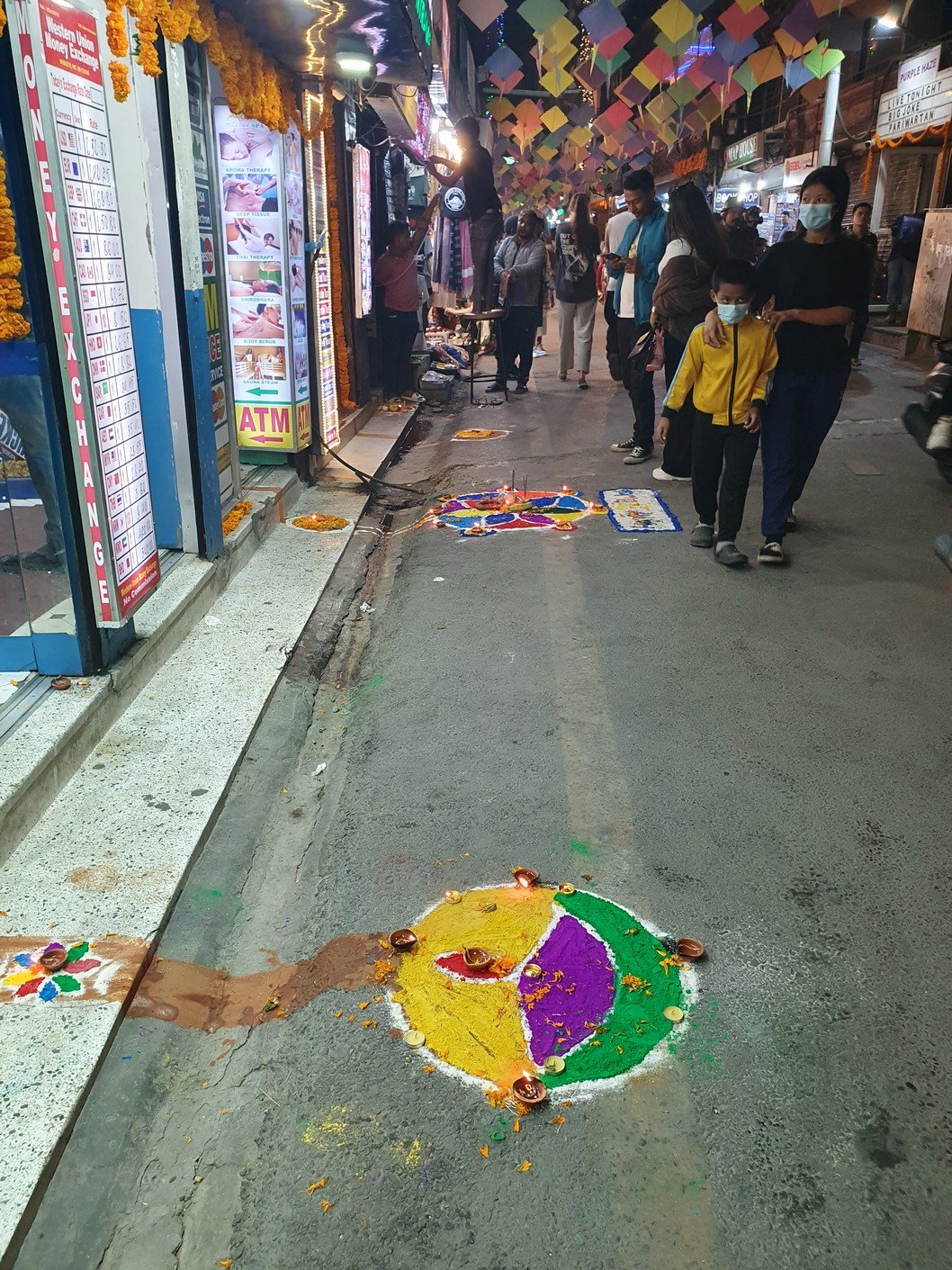
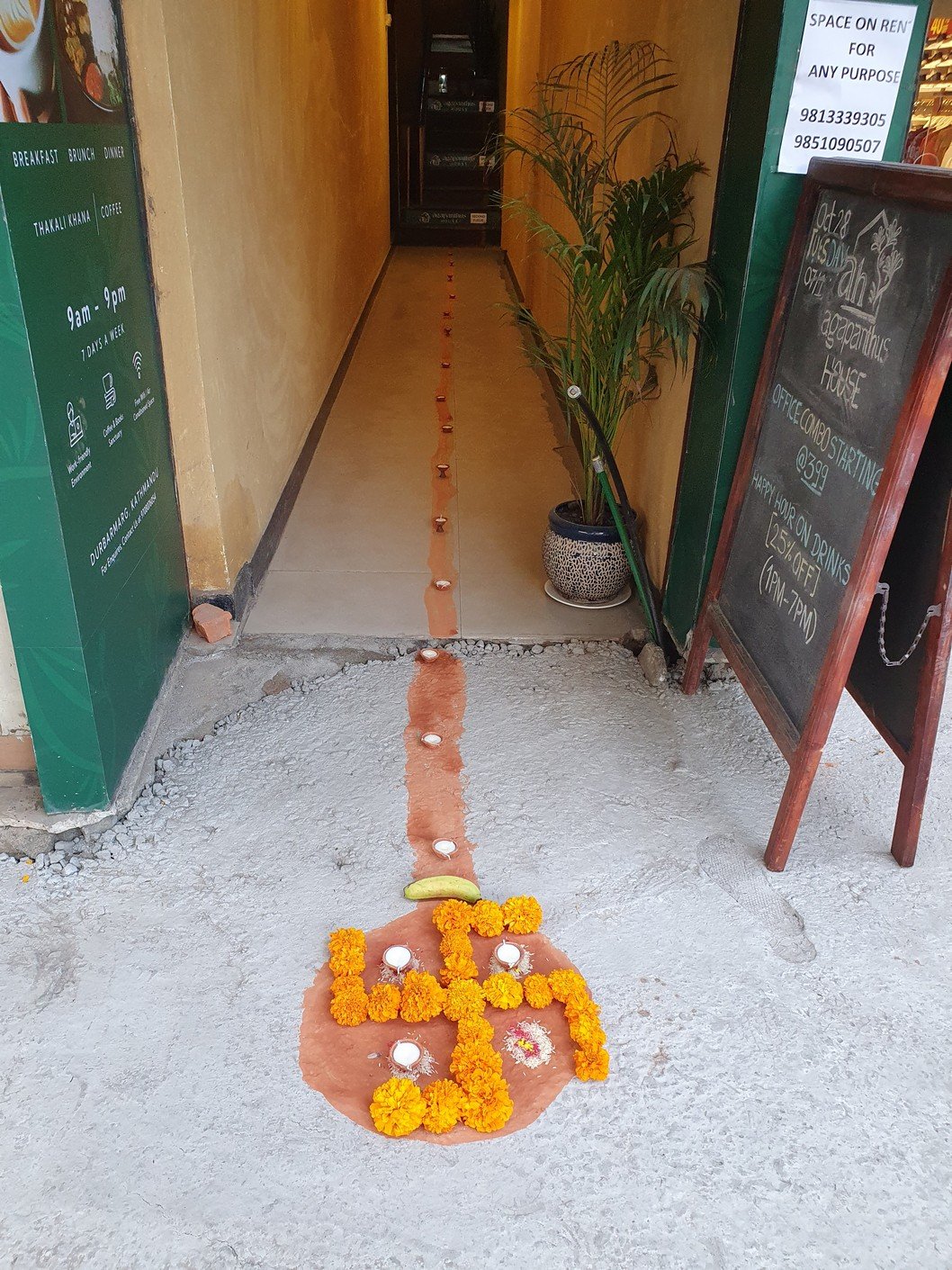
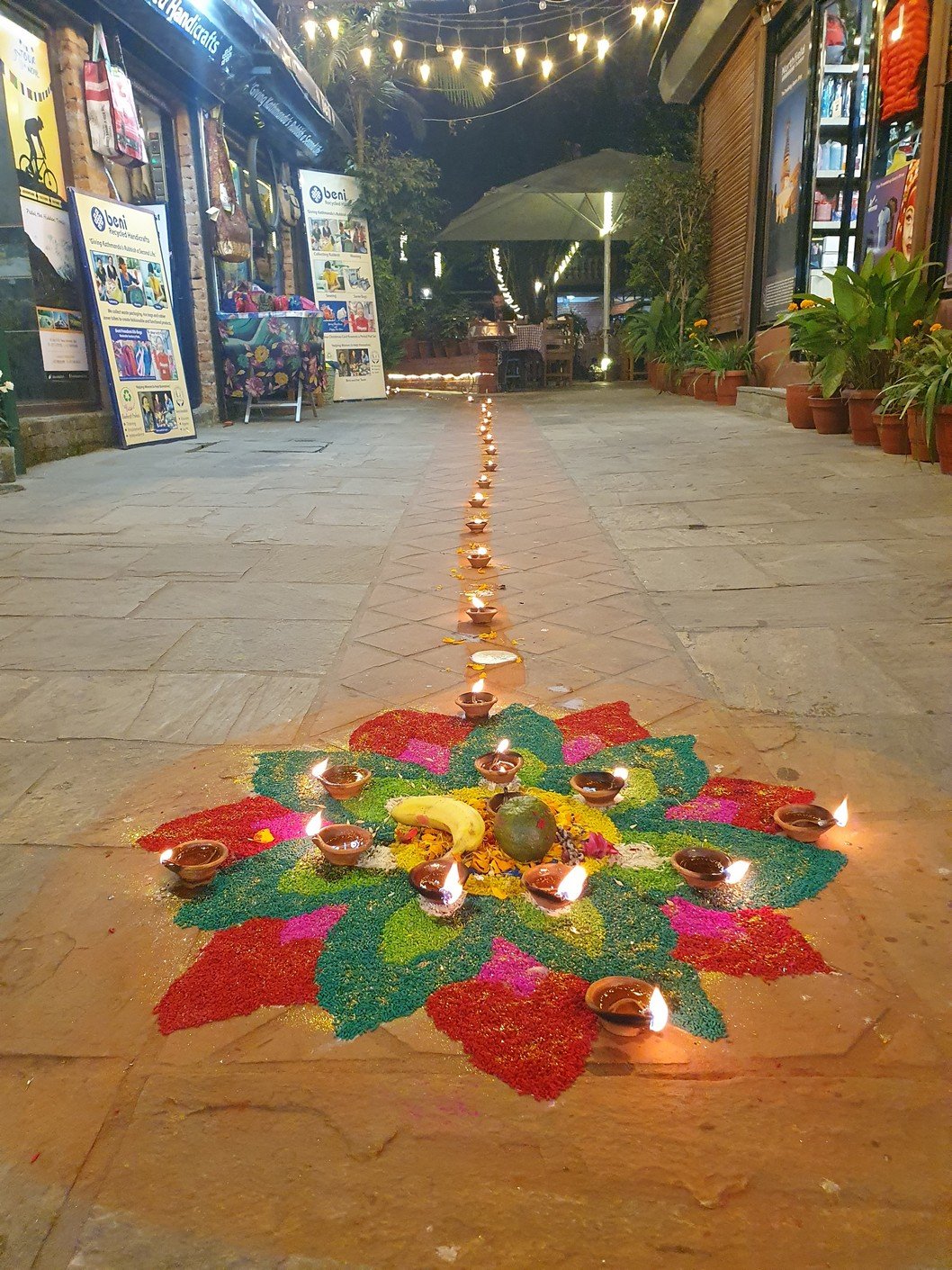
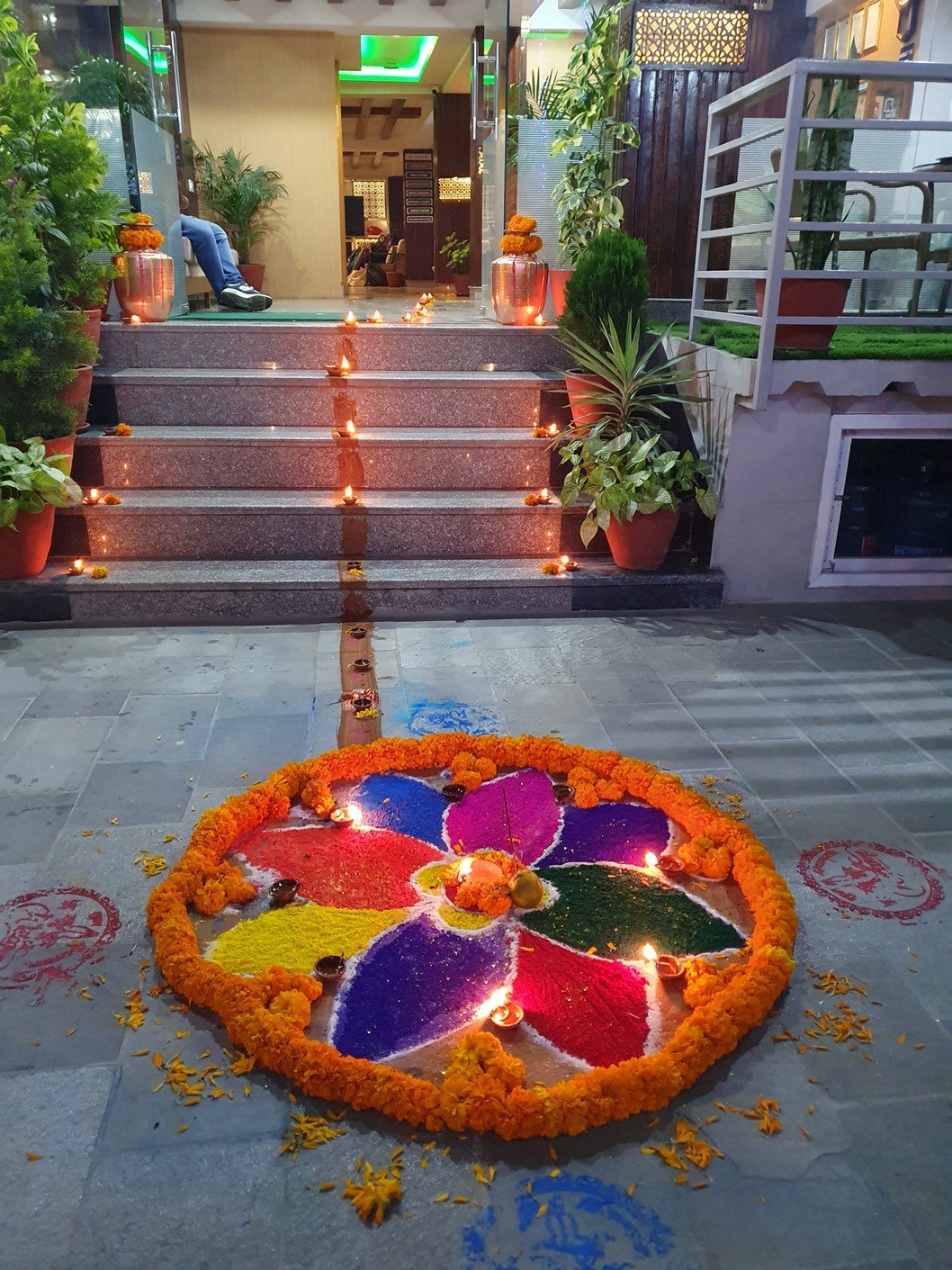
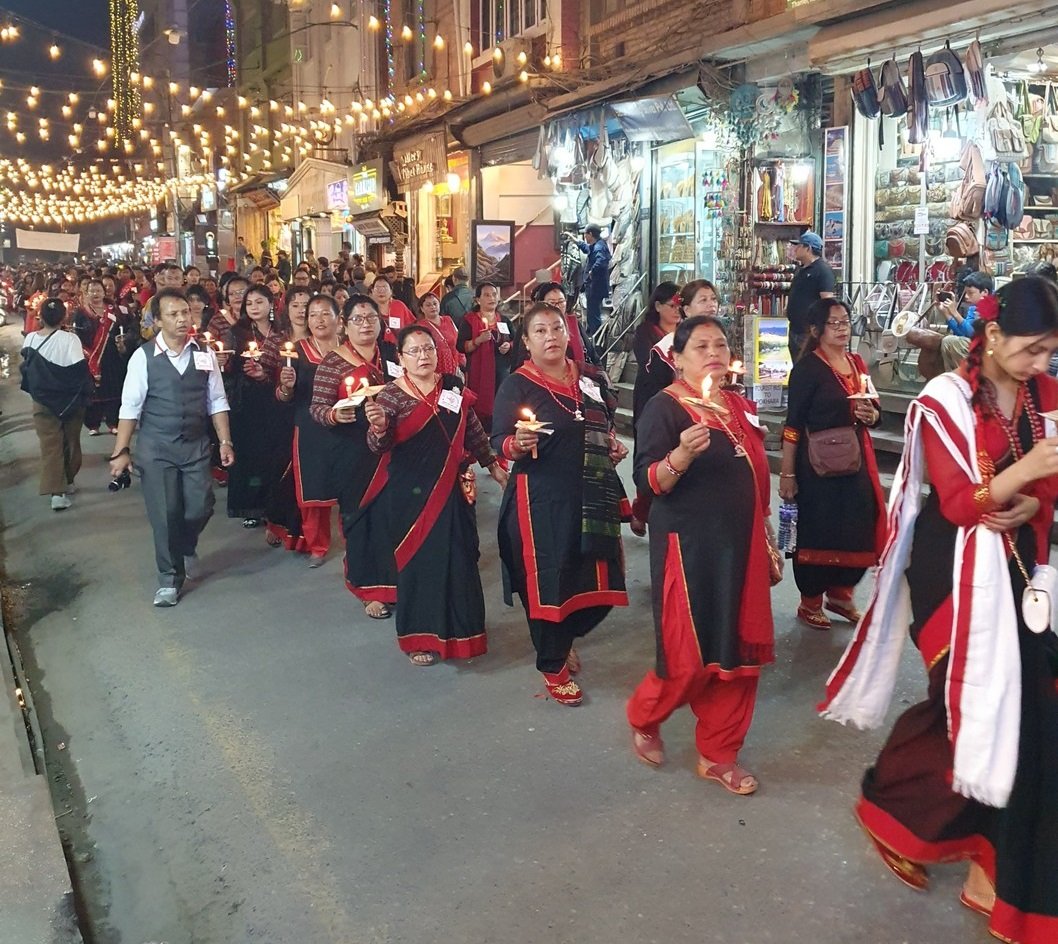
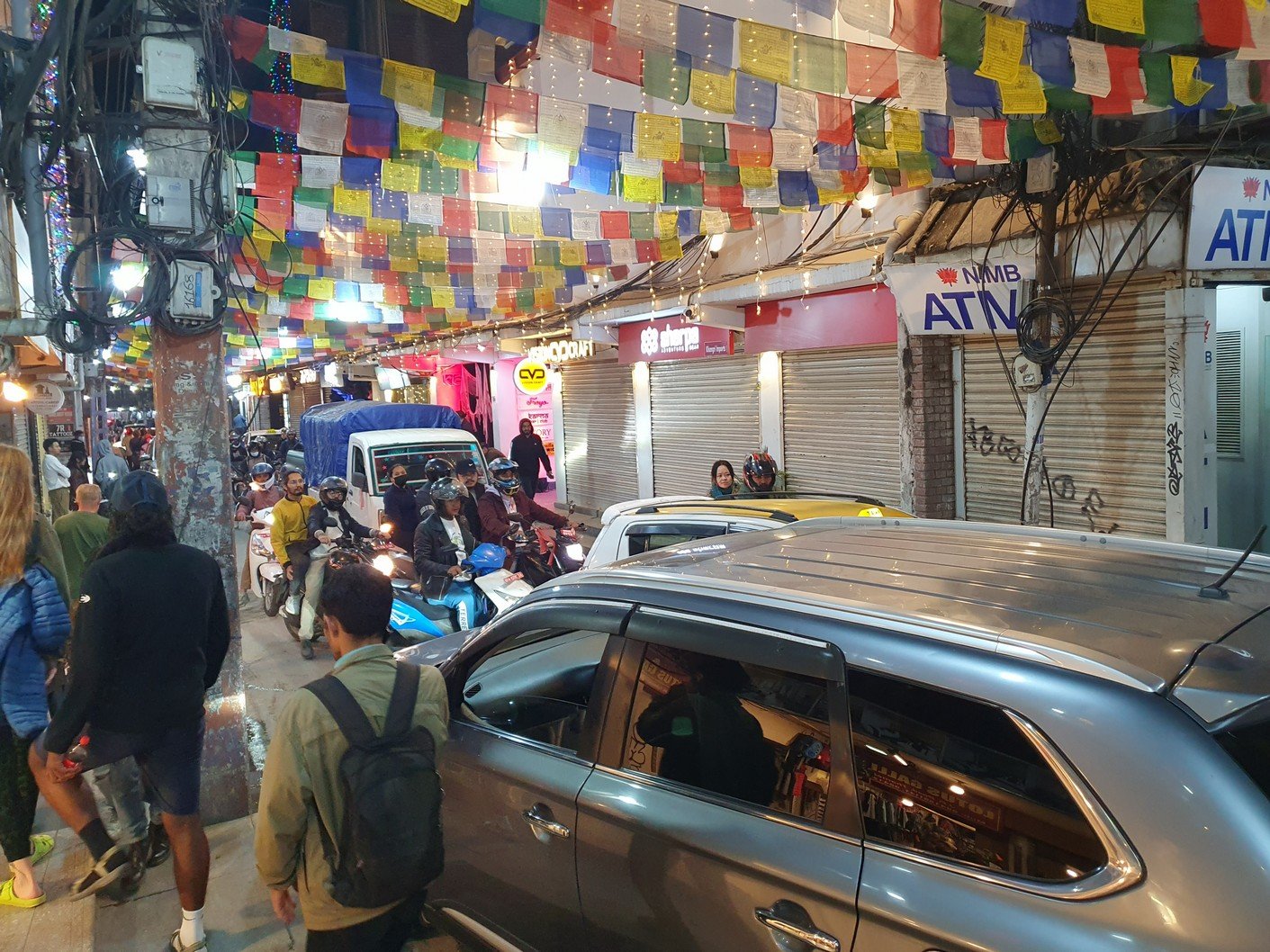
Diwali, perhaps the most important Hindu festival, is celebrated between October and November, and it really shows on the streets. The streets of the city center are decorated with prayer flags and the biggest buildings are draped in LED light strips. Almost all shops, restaurants and hotels set up a mandala in front of their premises, and several parades circle the city center.
This restaurant set up a mandala so big that it was hard even to get inside.
Our hotel, of course, had its own decorations. Heikki, working in the construction industry, doubted that a candle path along the hotel corridors would be allowed in Europe.
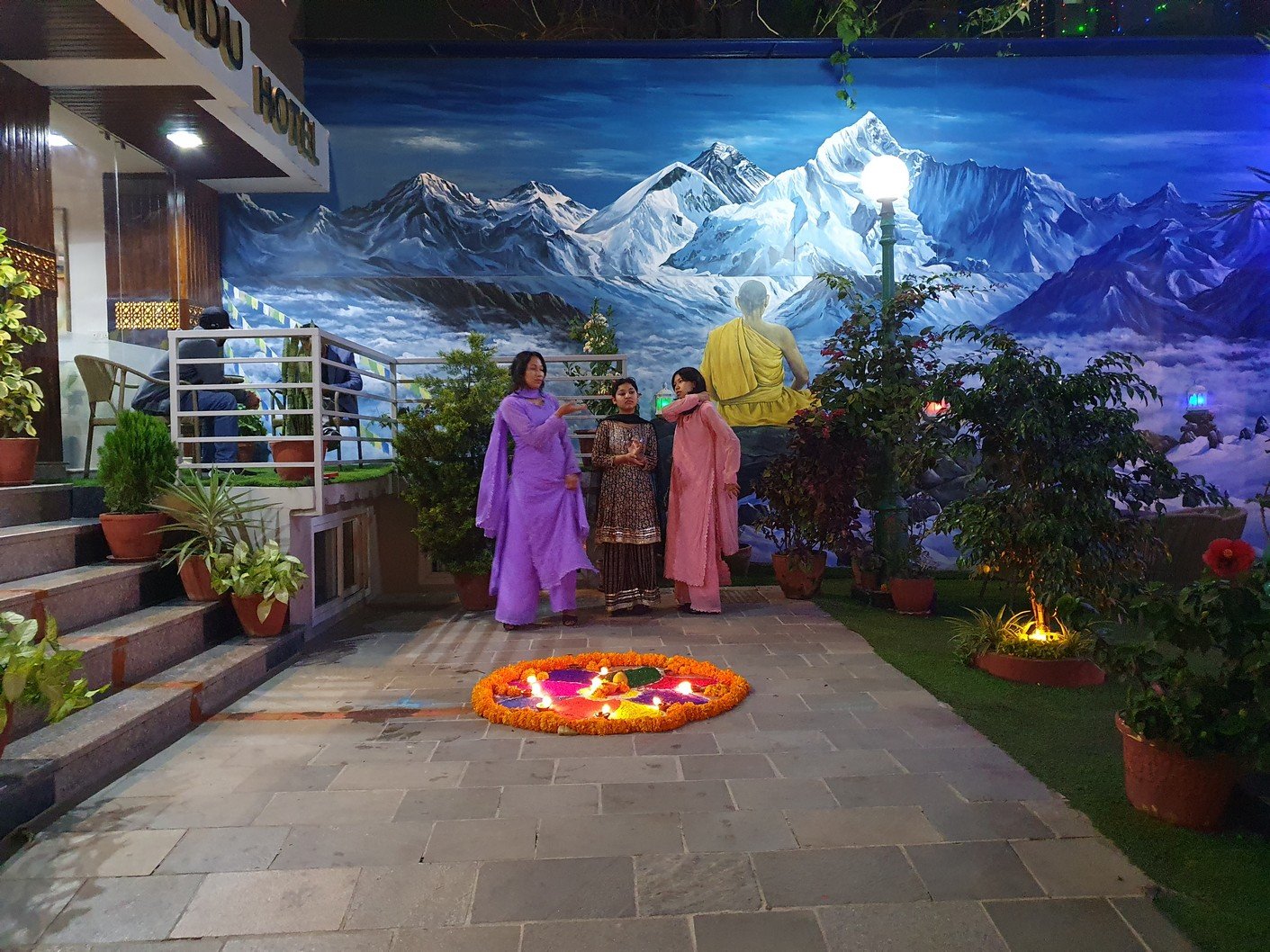
In the evening there was also a music and dance performance in the hotel courtyard
Even the dog participated in the festival mood
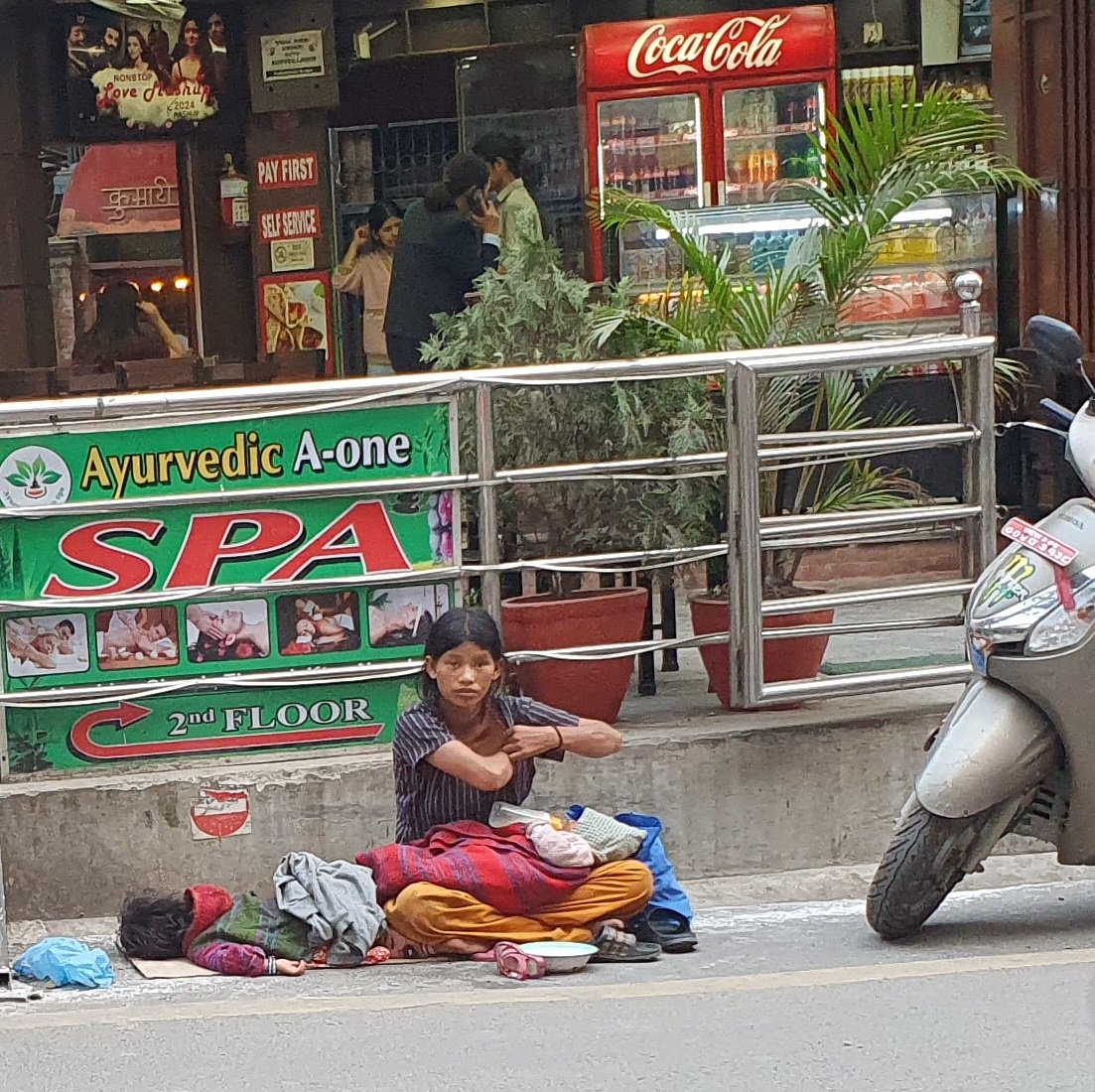
Nepal is one of the poorest non-African countries in the world, with a GDP per capita of less than $1,400. Social security payments or pensions are probably almost non-existent. However, there are hardly any beggars to be seen. Care for the elderly is provided by the family.
It's not fun for the local mother and children...
... but the Western lifestyle-unemployed hare hare waterheads are happy to drum away with social security from their birth countries funding their freeloading.
Nepal has its own unique time zone, GMT+5:45. Over the years, there have been frequent proposals to synchronise the time zone with India (GMT+5:30), but these proposals have not progressed. Oh my, what a surprise…
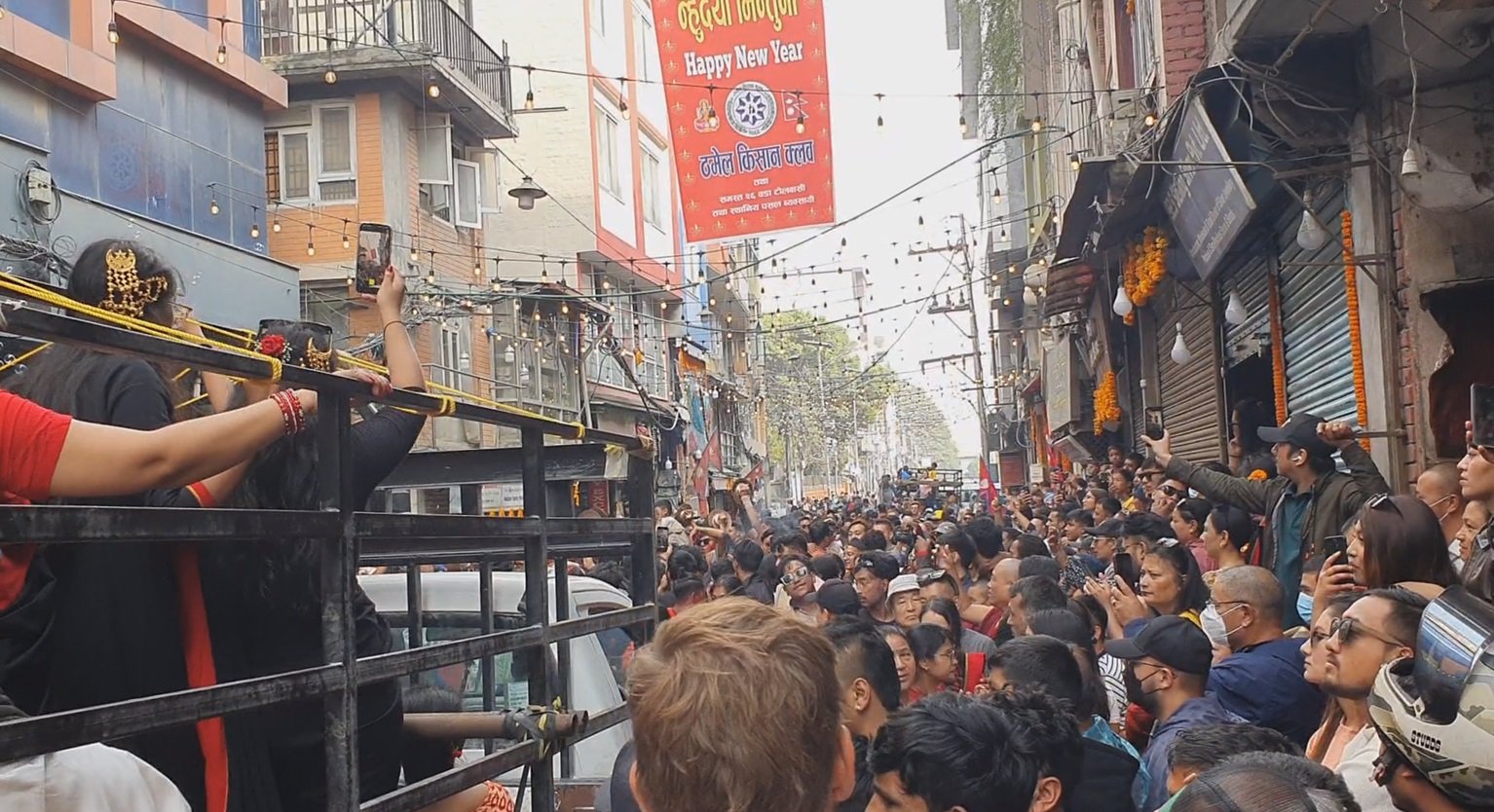
In addition to its own time zone, the Vikrami calendar is in use, according to which it is now year 2081. New Year’s Day is a complete mystery. According to an internet search, it is 13.4 or 14.4, depending on the year, but there seemed to be full New Year’s Eve celebrations going on in Kathmandu on the second of November.
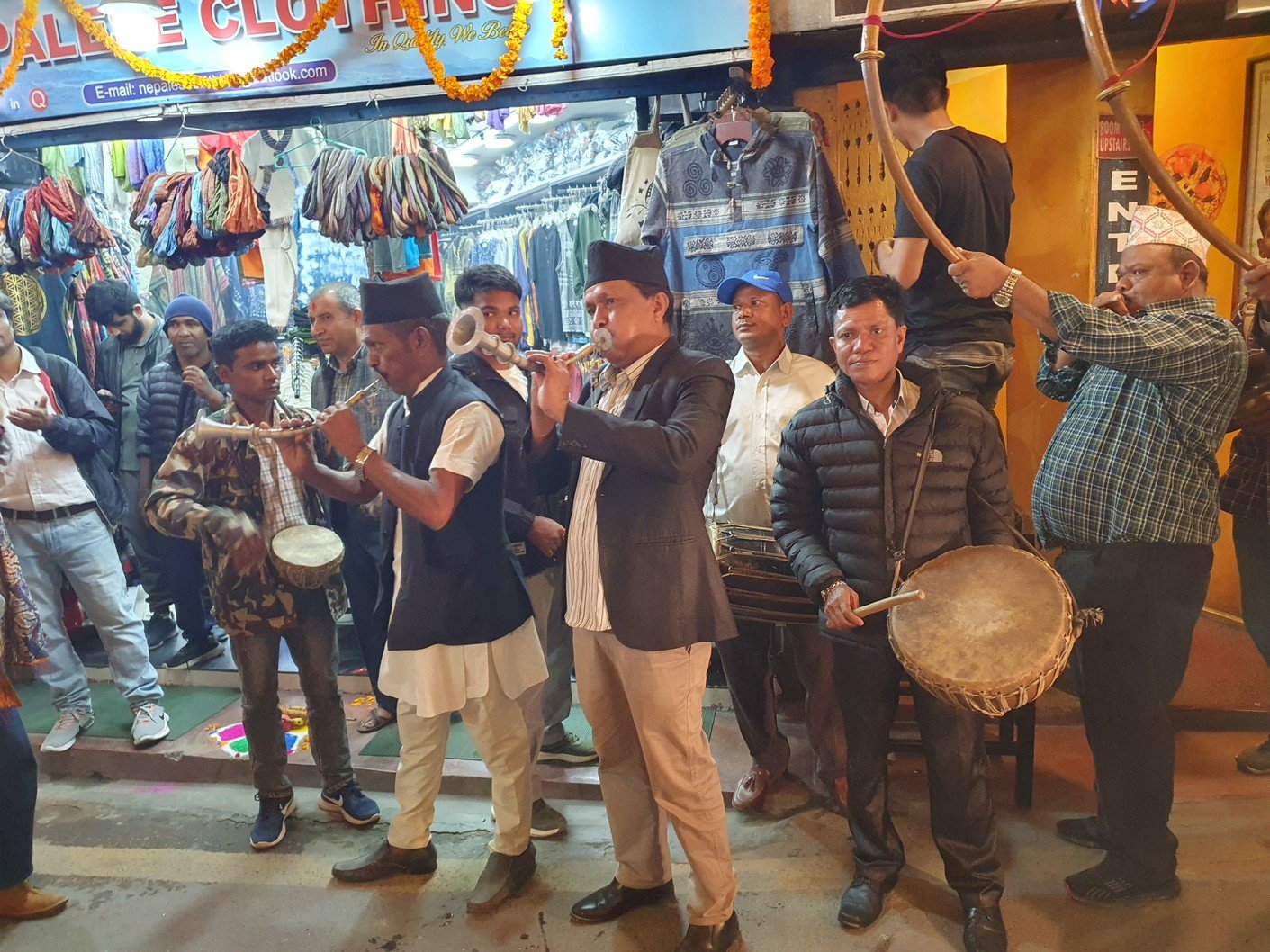
The number one priority of the New Year's parade was to produce the maximum amount of noise through drumming and blasting music.
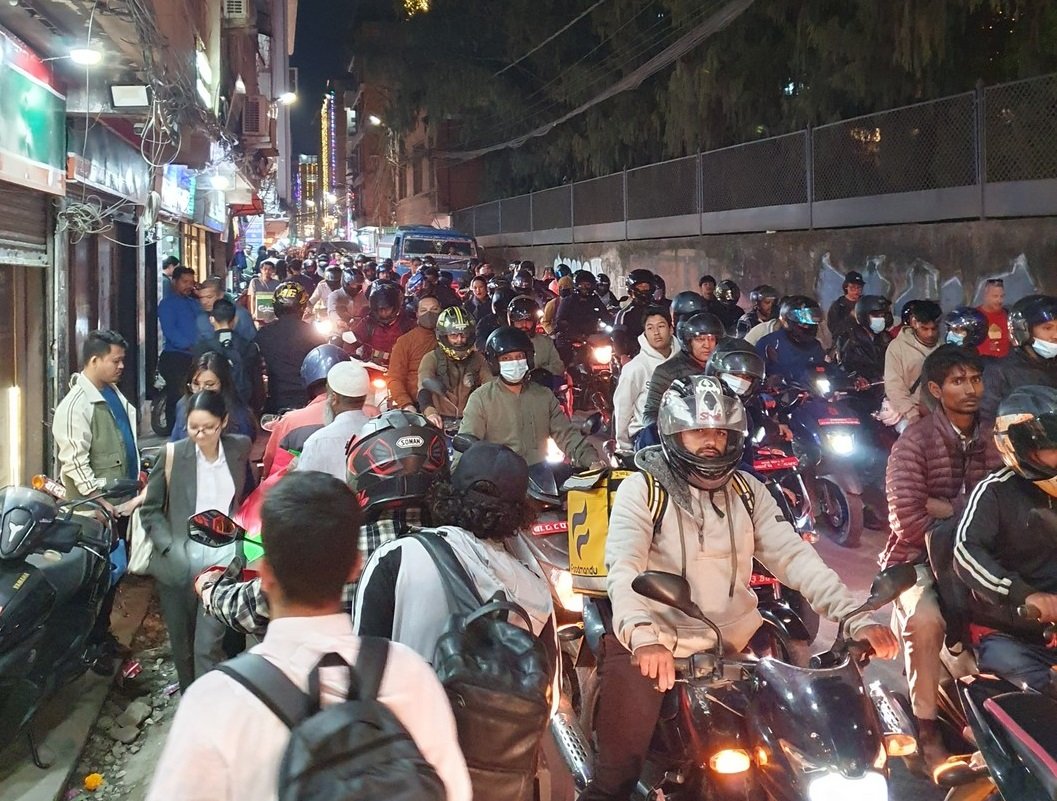
I have driven in many countries with my own car or a rental car, but in Nepal one might consider using external transport services. Purely for cost reasons of course! If you can drive your car at home, how hard could it be in Nepal?
Cruising in Thamel in a new BMW X3. What could go wrong?
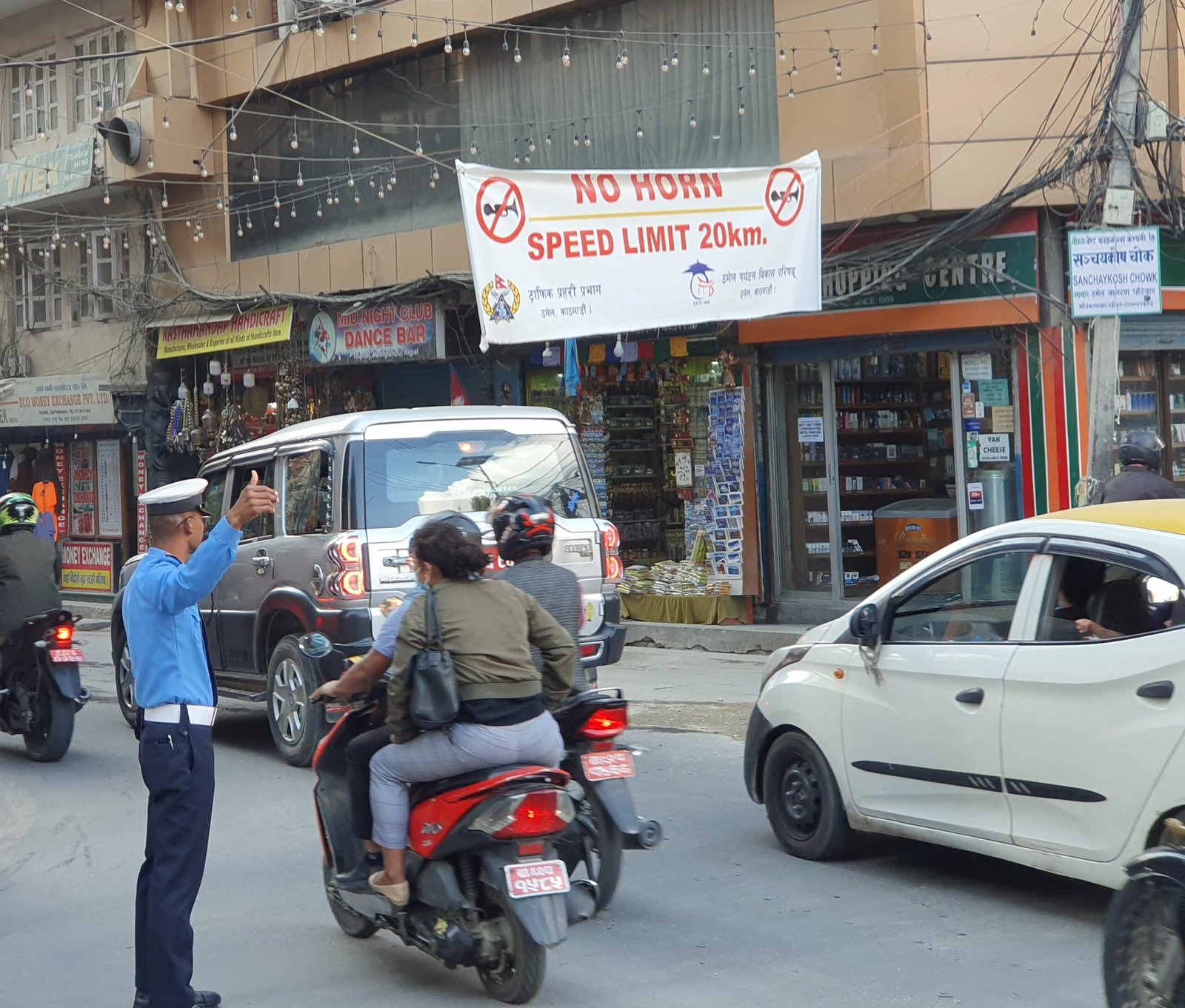
Congestion will prevent speeding, but the effect of the banner on horn use was pure zero
I wonder which is more important in the city centre: road safety or securing a key source of income (= Western tourists)?
Bored to sleep?
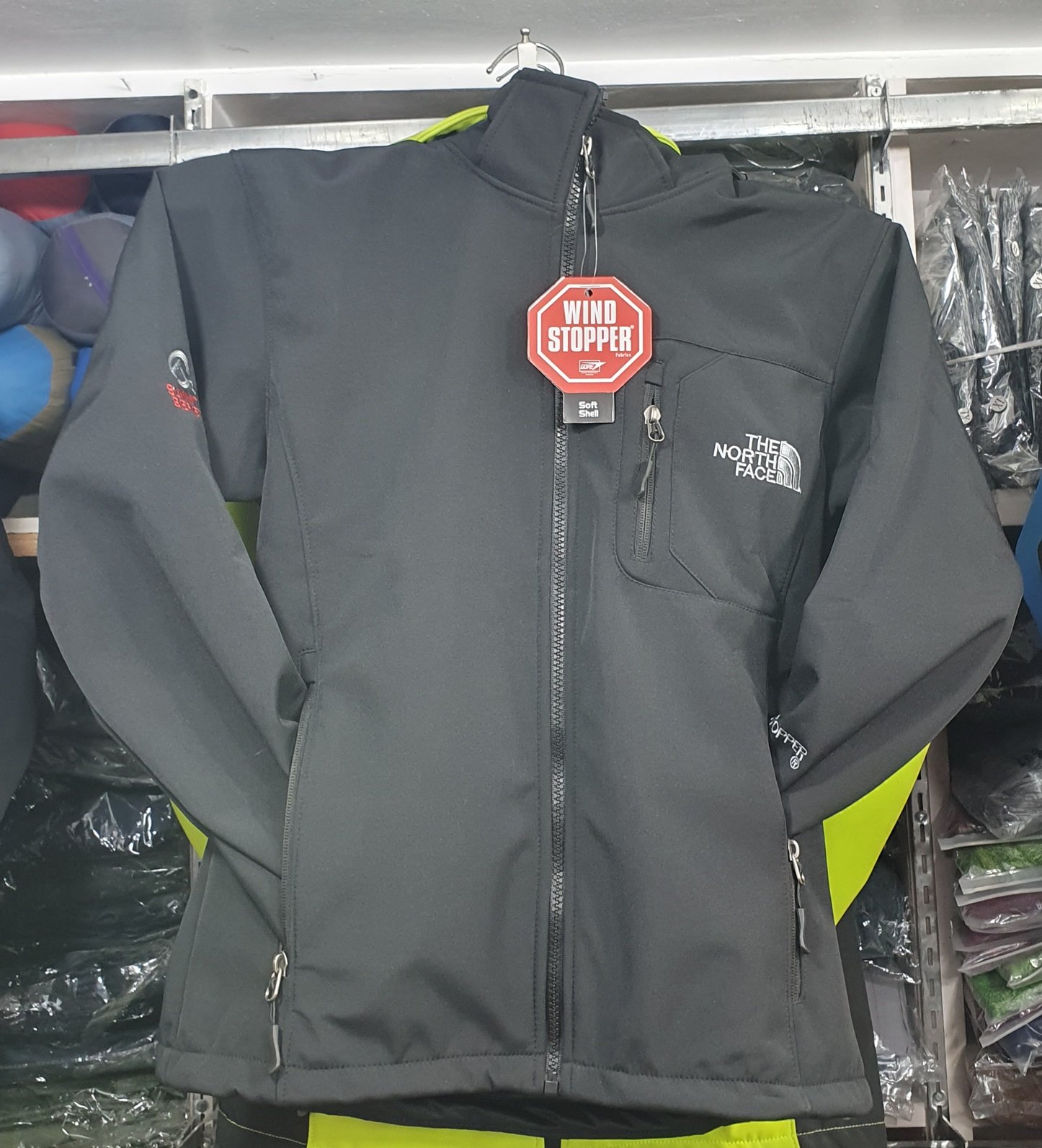
I have plenty of hiking gear from previous trips. Some of them were starting to fall apart and had to be thrown away. The waterproofing layer of one 20 years old pair of shell trousers and jacket was badly disintegrated and flaking off. The protective taping on the seams of another old windstopper fleece also had dried out and mostly peeled off. I bought a new thermal fleece jacket and a windstopper jacket for the terkking trip. The Mountain Equipment rucksack, which had been in constant use for ages, was starting to wear out too, but I thought I’d replace it with a quality product from some end-of-season discount back home.
Before the trek, I bought a short-sleeved ‘North Face’ hiking shirt and a long-sleeved ‘Patagonia’ microfleece really cheaply in Kathmandu, and they were in heavy use and proved to be excellent products. Otherwise, shopping in Kathmandu was limited to equipping the rest of the family. Nepal does not use children’s centimeter sizes like 140/148 and the traditional S/M/L/XL sizes are not quite one to one with ours either. The hiking shirt, microfleece and t-shirt from the tour operator were all size XXL, although I wear size XL back home. For the clothes for the family members, I was given colour preferences and measurements from shoulder to lower arm, which helped me to find the right products and sizes. In hindsight, I am happy to say that all the clothes I bought were the right size for my wife and children.
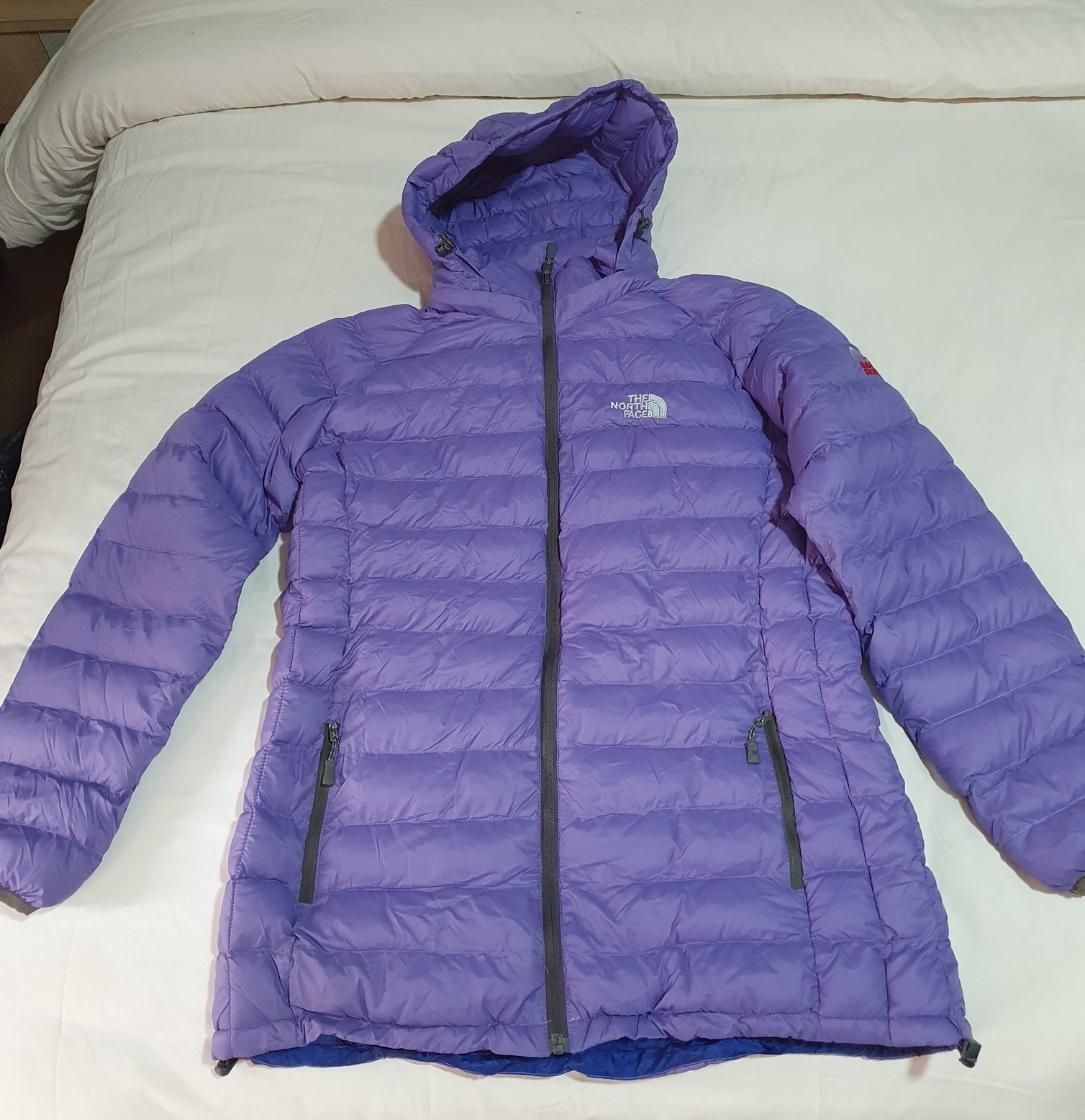
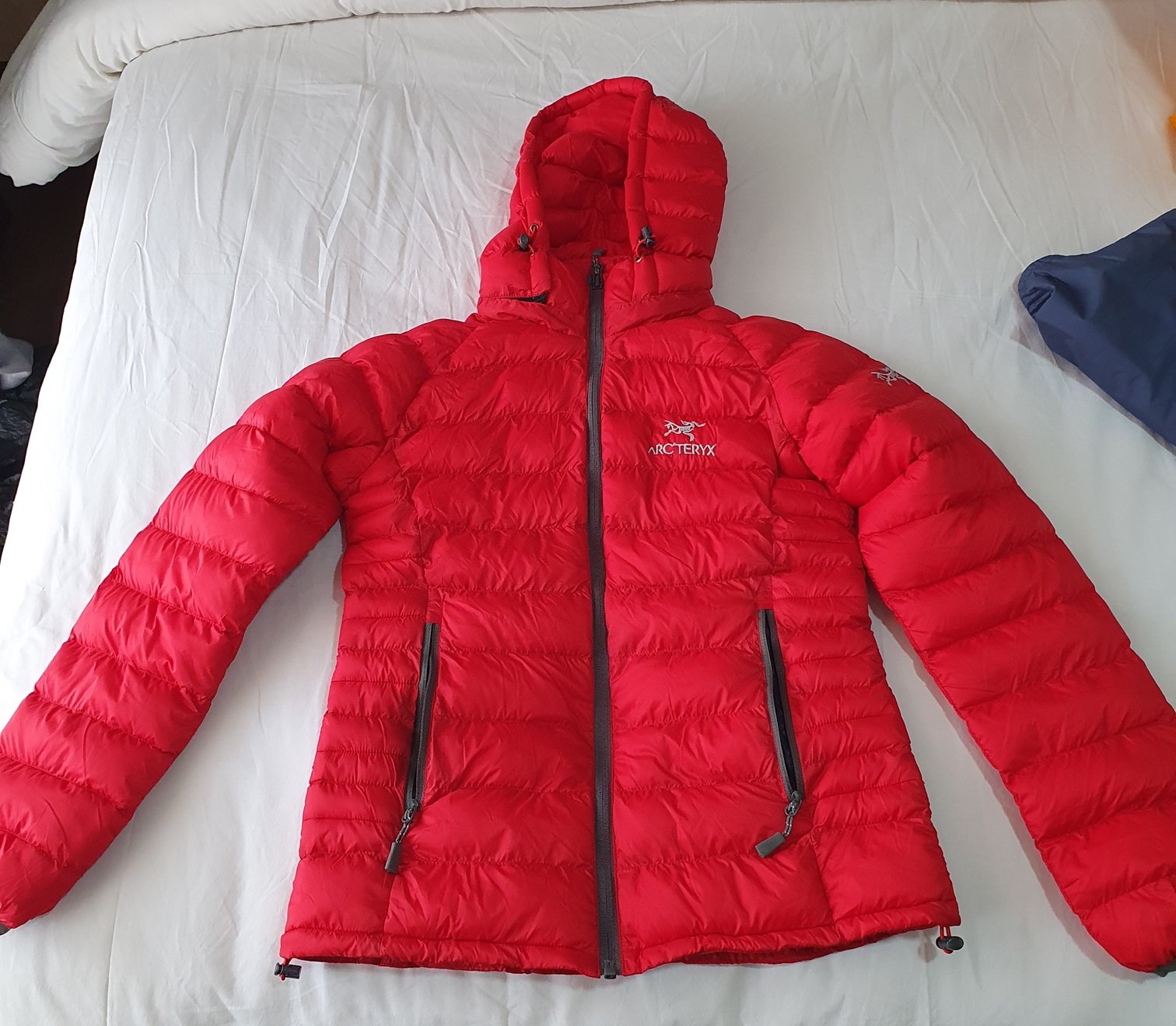
The ‘down jackets’ cost about thirty euros each, the windstoppers about twenty euros each and the locally produced fleece was about ten euros. I’m quite certain that the places where I bought them were not part of the official North Face or Arcteryx retail network, but the products seemed to be of reasonable quality. In any case, they are for everyday use in urban conditions, and they should offer good value for money in such use.
Down jacket for Jaana
Down jacket for Ronja
Down jacket for Risto
Windstopper for Ronja
Windstopper for Risto
Fleece for Risto
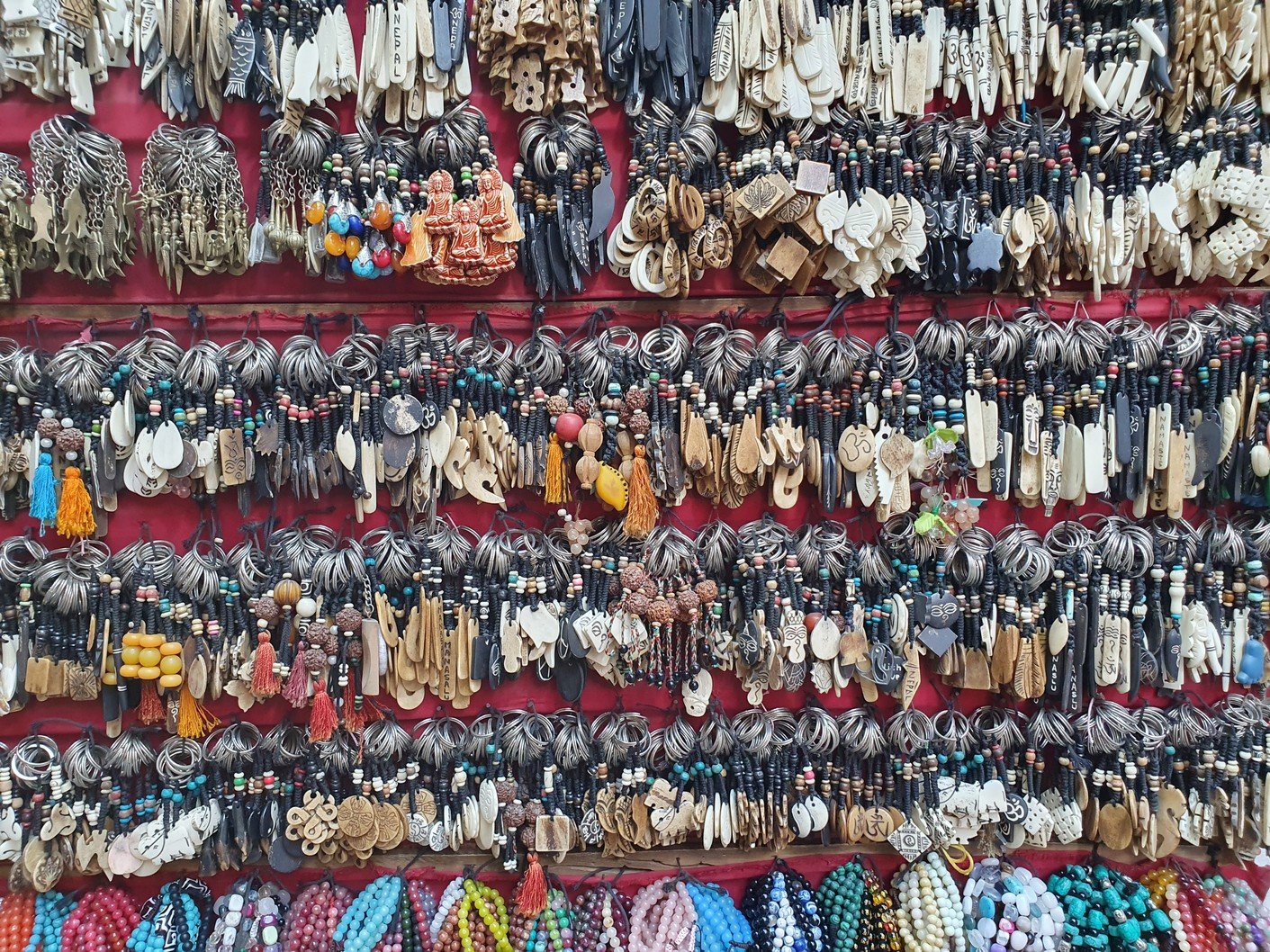
According to my quick calculations, there were about seven million different kinds of jewellery and trinkets on offer. Even winning the lottery is more likely than picking a handful of just the right trinkets from that mass. But no worry, modern technology rescues the day. I took photos of the trinkets and sent them to Ronja by Whatsapp. In return, I got pictures with the right trinkets circled. Technically an excellent and effective tactic, but I did stumble on some slight challenges during the implementation phase. Which of the thousands of similar looking trinket shops were these specific pictures taken from? Fortunately, I had plenty of time to go around Thamel so many times that I finally found everything.
Saturday was departure time. Heikki and Pude left for Delhi already in the morning, but I had a flight via Doha at two o’clock at night. So I had to be at the airport around ten o’clock in the evening. Both because of the flight and because Saturday was the expiry date of my 30-day visa. So check-in had to be done before midnight to avoid any hassles with the visa. The hotel gave me an extension of an hour and a half for checking out, after which I left my stuff at the hotel for storage. I wandered around the city for a few more hours and had a bite to eat. I returned to the hotel with a soda and a pastry and settled down at the end of the lobby to work on the blog and to go through photos. The extra time was quickly used up and soon our tour operator, Limbu, came to pick me up for the airport. In the evening there was not much traffic and the seven kilometer journey was completed in a fraction of the time it had taken on arrival.
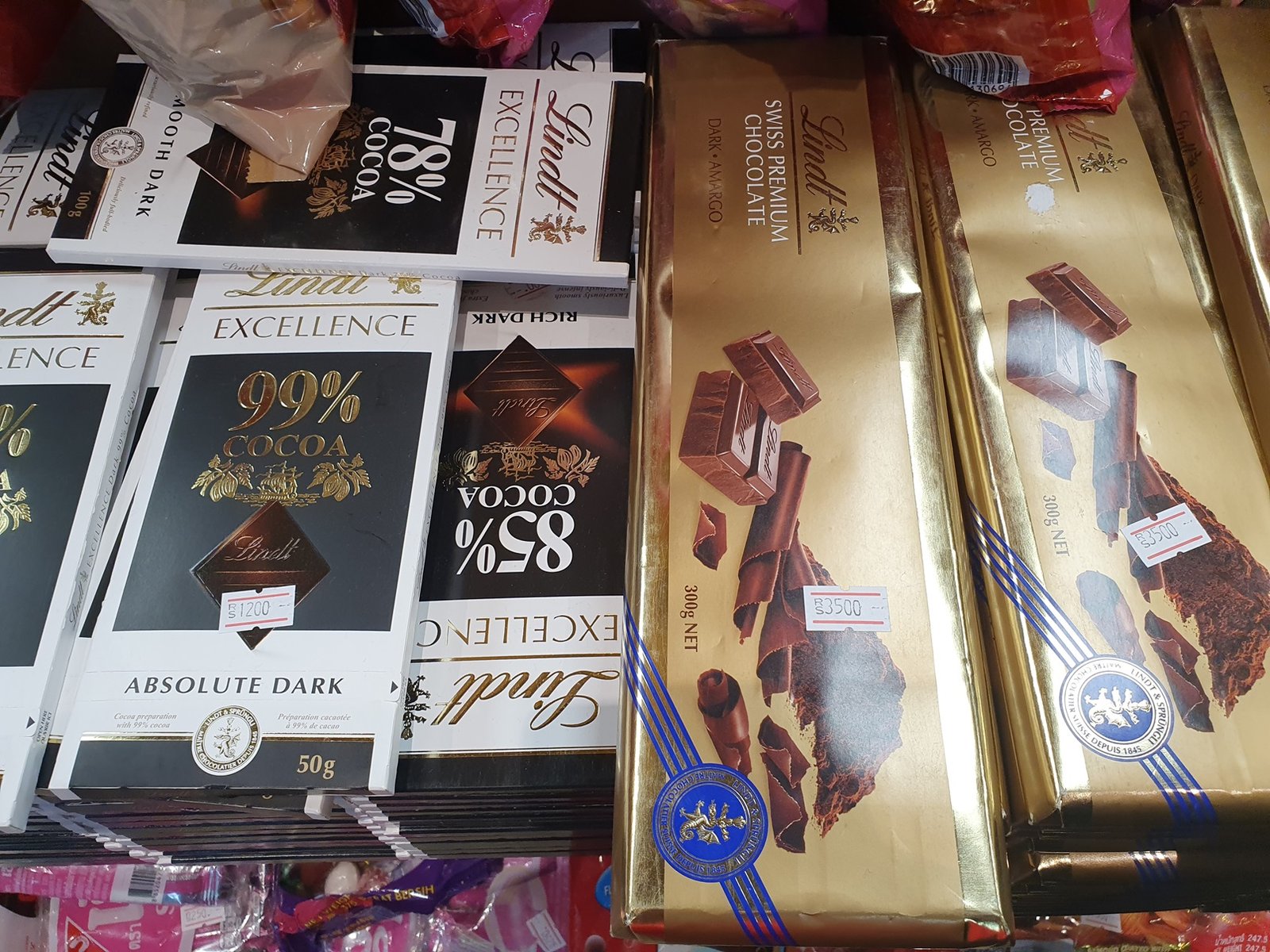
Kathmandu has a reasonably large airport as it is Nepal’s only international airport and there are quite a few flights. However, there are virtually no services at the airport. There was one kiosk in the check-in hall. After security check, representatives from the local lounge tried to market access to the lounge and the primary promotional punch line was that ‘there is nothing in the gate area’. This was largely true, but the lounge entry was so expensive that I didn’t consider it even though I had quite a bit of extra time before boarding time. I still had few thousand rupees to get rid of. If you want to get rid of your money, it is generally very easy to do so at airports. Unfortunately, like the old wisdom of the jungle tells us, every rule has an exception. And in this case, that exception is Kathmandu Tribhuvan International Airport. There were no shops or a tax-free zone at the gate area. There was only one combination of a kiosk and a café, which offered practically nothing you would want to buy even with leftover currency. On sale were coffee products, mysterious local crisps, mostly child-sized Nepal/Kathmandu t-shirts, nuts and raisins with no prices and international chocolates at absolutely cosmic prices. Lindt’s 50 grams of 99% chocolate cost €8 and 300 grams of milk chocolate an insane €23. No matter how much the rupees burned in my pocket, chocolate shopping would have to wait until Finland and K-Supermarket. In the end, I bought a bag of local cheese balls, a bottle of Pepsi and a…. fridge magnet! Maybe the fridge magnet man knew what he was doing after all! The rest of the money was left as souvenirs for the kids.
P.S. The cheese balls ended up in the trash can.
P.S.2 The most observant travellers may notice subtle differences between Kathmandu and Doha airports. Doha is a gigantic airport, adapted to the living standards and self-promotion of the oil countries, where you can buy a Porche instead of cheese balls. Doha, along with Dubai, serves as a intercontinental hub, and if you have a couple of hours before your flight, there’s no point in searching for it in the four-screen departures info yet. And that’s true even in the middle of the night, because many of the long-haul connections are made in the middle of the night, as in my case.
3500 rupees for a 300 gram chocolate bar. No deal.
Our fridge now stares accusingly at anyone seeking late night treats